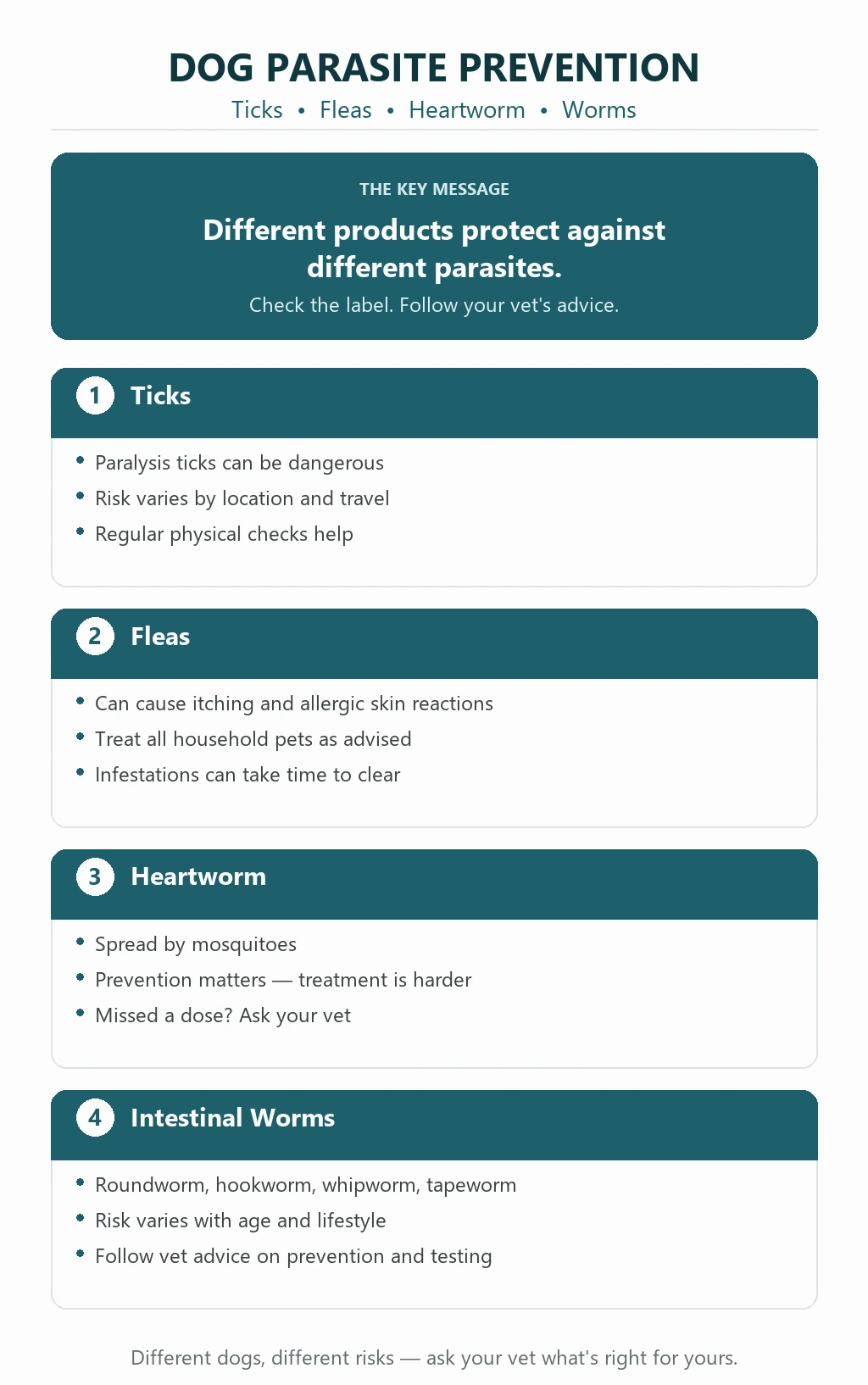
Australian dogs can face several completely different parasite threats at once — and the right prevention plan depends on where your dog lives, how they spend their time, and exactly which product you're using. This guide covers what each parasite group means for your dog, why a "one size fits all" approach doesn't really exist, and how to build a sensible, gap-free prevention routine.
This page provides general educational information for Australian dog owners. It does not replace the product label or advice from your own veterinarian — always follow both for your individual dog.
Which parasites does my dog actually need protection from?
Depending on where you live and how your dog lives, they may need protection against up to four separate parasite groups:
- Ticks
- Fleas
- Heartworm
- Intestinal worms
One product does not necessarily cover all of them.
The right prevention plan depends on:
- Where your dog lives or travels to
- Their lifestyle and outdoor exposure
- Age and health
- Other animals in the household
- The exact product(s) you're using
Check the coverage and dosing interval printed on your actual product — don't assume "all-in-one" means every parasite is covered.
Ticks
The paralysis tick is the tick that matters most in Australia — it can cause severe illness and, without treatment, can be fatal. Risk is geographically concentrated, particularly along parts of the eastern seaboard, though cases are increasingly reported further afield, so a dog travelling into a tick-prone area may need protection even if their home region is lower-risk. Tick activity and distribution can also vary with season and climate, so avoid assuming a single fixed "tick season" applies everywhere in Australia.
Manual tick checks are a genuinely useful habit, but they don't replace an effective preventive product — a check can miss a tick, and by the time one is found, it may already have been attached for some time. Run your hands over your dog regularly, checking:
- Head and ears
- Around the eyes and lips
- Neck and collar area
- Armpits
- Groin
- Between the toes
- Under the tail
Finding and removing a tick does not mean the danger has passed. If your dog shows weakness, wobbliness, changed breathing, or vomiting/retching after possible tick exposure, treat it as an emergency and get urgent veterinary assessment — this isn't something to manage at home.
For tick identification, the removal method, and regional hotzone detail, see our National Dog Travel & Tick Safety Guide.
Fleas
Fleas are more than an itching problem. Beyond general skin irritation, some dogs develop flea-allergy dermatitis — an intense allergic reaction to flea saliva that causes disproportionate itching, hair loss and skin damage from just a small number of bites. Heavy infestations can be more serious in young, small or unwell animals, and fleas are also the way dogs pick up flea tapeworm, so a flea problem can quietly become a worm problem too.
An established household infestation can take time to control, because fleas spend much of their life cycle off the dog — in carpet, bedding and the yard. Treating only the visibly itchy dog often fails if other pets in the household are left untreated, since they can keep reintroducing fleas to the environment.
Heartworm
Heartworm is transmitted by mosquitoes, and prevention is far safer and simpler than treating an established infection. Risk varies geographically, but mosquito exposure and travel both matter — a dog visiting a higher-risk area can pick up an infective bite even if their home region is considered lower-risk.
If prevention has lapsed for any length of time, don't simply restart the old program — talk to your vet first, since giving some preventives to a dog that may already be infected can cause a serious reaction. Depending on your dog's age, location, history and current prevention status, your vet may also recommend a heartworm test.
There is no single testing interval that applies to every dog in Australia by default — how often testing makes sense is something your vet will judge based on your dog's individual prevention history and risk, not a fixed rule.
Intestinal worms
The major intestinal worm groups relevant to Australian dogs are roundworm, hookworm, whipworm and tapeworm. Depending on the species and the individual dog, intestinal parasites can contribute to gastrointestinal upset, poor body condition, and in some infections (notably heavy hookworm burdens) anaemia. Puppies are at particular risk, and a few worm species carry zoonotic (human health) significance as well.
Faecal testing is sometimes recommended by vets, particularly where a dog has ongoing symptoms, higher exposure (scavenging, raw feeding, contact with other animals), or a pattern of repeated infection — it's a useful tool rather than something every dog automatically needs.
Hydatid tapeworm and zoonotic hygiene
Because this is an Australian guide, it's worth a practical word on zoonotic risk — parasites that can pass between dogs and people. Hydatid tapeworm is the best-known example: dogs that scavenge or are fed raw offal from livestock or wildlife can become infected, and the eggs shed in their faeces are the way people are exposed, usually through hand-to-mouth contact after handling contaminated soil, sand or faeces.
Sensible everyday precautions cover most of the risk: pick up dog faeces promptly, wash hands after handling faeces or soil, supervise children around soil or sandpits dogs may have accessed, and avoid feeding raw offal from livestock or wild animals where that creates a parasite risk. If you're in a rural, farming or hunting situation with higher exposure, it's worth discussing tailored precautions with your vet.
Geography matters — Australia doesn't have one risk profile
This is probably the single most important idea in this guide: there's no one parasite-risk profile that applies to every dog in Australia. A few examples of how much this varies:
- Paralysis-tick exposure is particularly concentrated along parts of the eastern seaboard, though it isn't limited to one strict boundary.
- Mosquito-borne heartworm risk shifts with climate, season and location.
- Warmer, more humid environments can support flea activity for much of the year rather than a short season.
- Travel changes the picture — a dog holidaying somewhere higher-risk than home may need extra protection for that trip.
Rather than a rigid state-by-state schedule, the practical takeaway is: tell your vet where your dog lives and where they travel, and let that shape the plan. Our Winter Dog Safety Guide covers how seasonal risk shifts by region, and our National Dog Travel Checklist is a useful starting point before a trip.
Avoiding gaps and accidental double-dosing
A common, easy-to-miss risk isn't under-protection — it's owners unintentionally combining products whose ingredients or parasite coverage overlap. Keeping a simple record helps avoid both gaps and duplication. For each product, note:
- Product name
- Active ingredient(s), if known
- Parasites it covers
- Date administered
- Next dose/date due
Before combining multiple parasite products, check with your vet or a veterinary pharmacist that the specific combination is appropriate for your dog — don't assume a combination is safe just because both products are sold separately for dogs.
What should I do if I've missed or given a late dose?
There's no single "just give it now" answer that applies to every product. What to do next depends on which product it is, how late the dose is, which parasite it's meant to prevent, and your dog's actual exposure risk. Check the product label first, and contact your vet if you're unsure — this matters especially for heartworm prevention, where a gap can have more serious consequences than a short delay with some other treatments.
Puppies, seniors and medically complex dogs
Standard adult-dog advice doesn't automatically apply to every dog. Prevention planning deserves extra care for puppies, very small dogs, senior dogs, pregnant or nursing dogs, dogs already taking other medications, and dogs with known neurological or medical conditions. If your dog fits any of these groups, it's worth confirming your specific product and schedule with your vet rather than assuming a standard plan applies.
⚠️ A note if you also have cats
Some parasite products made for dogs can be dangerous to cats. If you share a household with both, make sure any dog product is used exactly as directed on its label, applied only to the dog it's intended for, and never applied to a cat "just in case." Keep dogs and cats separated until a topical treatment has fully dried if the label recommends it.
Questions owners actually ask
Does my dog need parasite prevention all year?
For many Australian dogs, yes — but it depends on the parasite and your location. Warmer, humid regions often support flea and mosquito activity for most or all of the year, while other risks shift seasonally elsewhere. Your vet can tell you what applies to your specific region and situation.
Does one treatment cover ticks, fleas, heartworm and worms?
Sometimes — some combination products cover several parasite groups, but not all products cover everything, and coverage varies by brand. Check your specific product's label rather than assuming "all-in-one" branding means total coverage.
Does my dog need tick prevention if we don't live in a tick area?
Possibly still yes if your dog ever travels to a tick-prone area, since exposure during a trip can matter even if home is lower-risk. Talk to your vet about your travel plans.
What happens if I miss a heartworm dose?
It depends on the product and how late the dose is. Check the label and contact your vet — heartworm gaps are one of the situations where it's worth getting advice rather than guessing, since simply restarting isn't always appropriate.
Can I use two parasite products together?
Only check with your vet or a veterinary pharmacist first — some combinations are fine and others overlap in ways that create risk. Don't assume a combination is safe without checking.
Why does my dog still have fleas after treatment?
Often because the environment (bedding, carpet, yard) or other pets in the household haven't been treated too — fleas spend much of their life cycle off the dog, so treating one animal in isolation can fail to break the cycle.
Should my dog be tested for worms?
Sometimes — faecal testing is useful where there are symptoms, higher exposure, or repeated infections, but it isn't a routine requirement for every dog. Your vet can advise based on your dog's situation.
Does an indoor dog still need parasite prevention?
Often yes, in some form — mosquitoes, fleas and worm eggs can all still reach an indoor dog via yard time, other pets, or visitors, even without heavy outdoor exposure. Your vet can help judge how much this reduces (rather than removes) the risk for your specific dog.
A practical prevention record
A simple record like this — kept on the fridge, in a notes app, or wherever you'll actually see it — makes gaps and overlaps much easier to spot. If one product covers more than one category, just note it in each relevant row.
| Prevention | Product | Last given | Next due | Notes |
|---|---|---|---|---|
| Tick | ||||
| Flea | ||||
| Heartworm | ||||
| Intestinal worms |
Sources & further reading
Medical information checked against veterinary and parasite-control sources including:
- Vet Voice (Australian Veterinary Association) — Pet Parasite Control
- Vet Voice (Australian Veterinary Association) — Heartworm Disease in Dogs and Cats
- Greencross Vets Australia — Ticks on Dogs: Identification, Symptoms, Prevention & Treatment
- Greencross Vets Australia — Fleas on Dogs & Cats: Treatment & Prevention
- Greencross Vets Australia — Intestinal Worms in Pets
- Victorian Department of Health — Hydatid Disease (Echinococcosis)
- Companion Animal Parasite Council — General Guidelines (general parasite biology and prevention principles; always follow Australian veterinary advice for local schedules)
This guide has not been reviewed by a veterinarian; it is written for general education and checked against the sources above. It is not a substitute for professional veterinary advice, or for the label instructions of the specific product you use, for your individual dog.