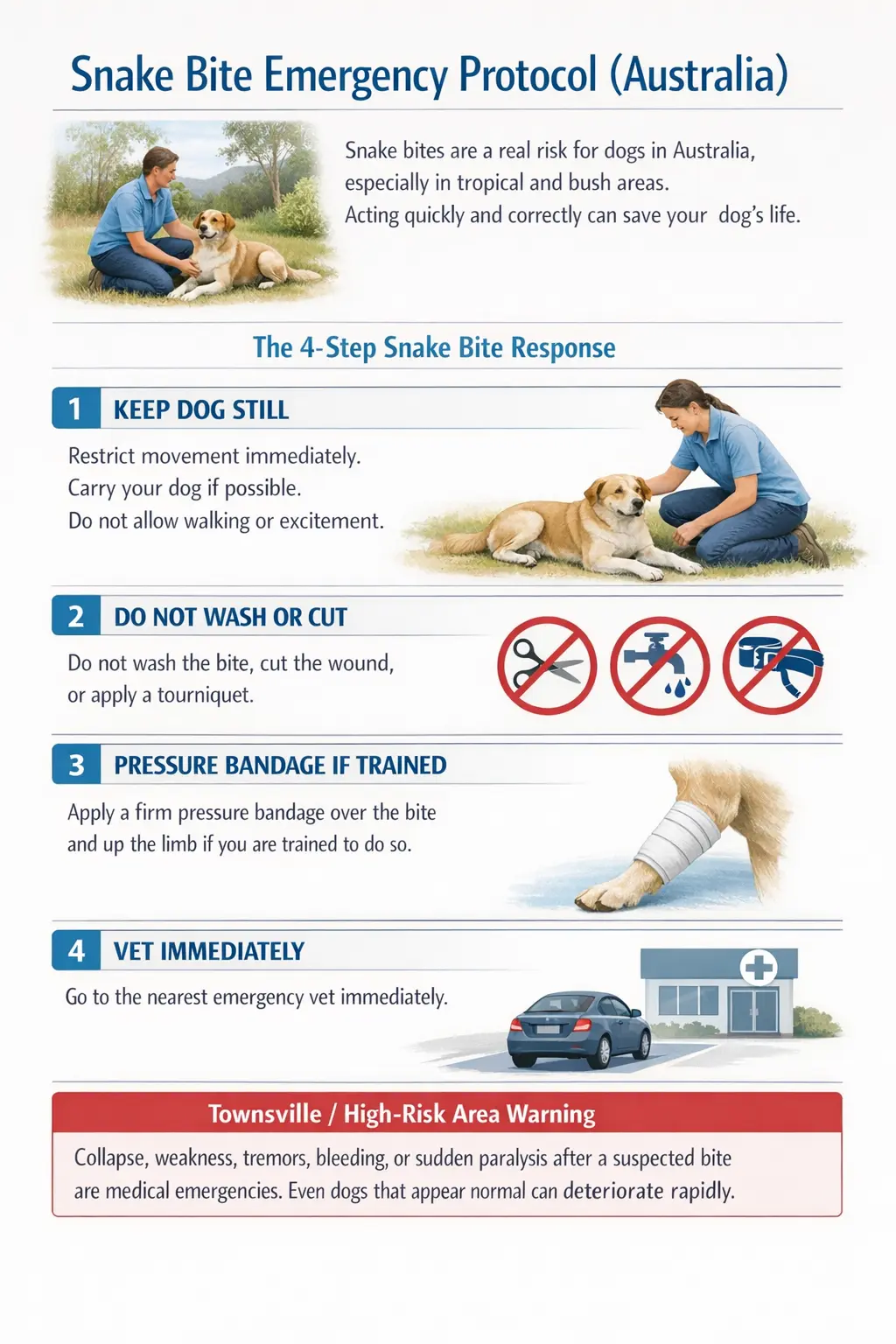
🚨 A suspected snake bite is a veterinary emergency
Australia is home to several medically significant venomous snakes, and a bite — or even a suspected bite — is always an emergency, wherever in the country you are. Do not wait for symptoms to develop. A visible bite mark is not required to treat this as an emergency: if your dog was near a snake and a bite is possible, contact a vet or emergency animal hospital immediately and start moving toward help.
Don't be reassured just because your dog seems normal right now — dogs can look fine in the first minutes after a bite and deteriorate later.
What To Do Right Now
KEEP DOG STILL
Move yourself and your dog calmly away from the snake first. Then restrict your dog's movement as much as possible — movement helps venom spread through the lymphatic system. Carry your dog rather than letting it walk, if you can. If your dog is too large or heavy to carry, get a second person to help, use a blanket, board or car seat as an improvised stretcher where practical, and otherwise minimise walking as much as reasonably possible — don't let unrealistic advice about carrying a large dog delay you from just getting moving toward the vet.
DO NOT WASH, CUT OR TOURNIQUET
Do not wash or clean the suspected bite site, cut the wound, try to suck venom out, or apply a tourniquet or anything that restricts arterial blood flow. Don't keep handling or repositioning your dog to search for a bite mark — it's often impossible to find under fur anyway, and the search itself just causes more movement.
PRESSURE BANDAGE — IF YOU CAN DO IT SAFELY
Australian veterinary guidance (including Greencross Vets) supports applying a pressure immobilisation bandage where possible, using the same principle as human snakebite first aid — firm, even pressure over the bite and up the limb, without cutting off blood flow. This is most practical when a limb bite is suspected. But don't let bandaging delay transport: if you don't have a bandage, or don't know how to apply one correctly, keeping your dog as still as possible and getting straight to the vet is the better choice over spending time on first aid you're unsure of.
CALL AHEAD, THEN GO — IMMEDIATELY
Call your vet or nearest emergency animal hospital, tell them you suspect a snake bite and that you're on your way, then transport your dog straight there. Don't wait at home to "see how they go" — time matters, and treatment started early gives your dog the best chance.
Also Avoid
- Don't waste time trying to catch, identify or kill the snake — your safety comes first, and treatment should never be delayed for identification. If you can safely note its general appearance from a distance without any risk to yourself, that may help the vet, but it's optional, not a requirement.
- Don't apply ice, or try any other home remedy.
- Don't let your dog walk around, sniff, investigate, or otherwise move more than necessary.
What Symptoms Might Appear?
Signs of envenomation can vary between dogs and don't always appear straight away — some dogs show nothing for a while before deteriorating. Possible signs include:
⚠️ Collapse, then "recovery," does not mean the danger has passed
A dog can collapse shortly after a snake bite and then appear to get back up and act normal for a while. This is a recognised pattern in Australian snake envenomation, not a sign your dog is fine — it should be treated as urgently as an ongoing collapse, with immediate veterinary treatment, not a wait-and-see approach.
Can't Find a Bite Mark?
That's normal — fang punctures can be tiny, hidden under fur, or impossible to find at all, especially soon after the bite. Don't spend valuable time shaving, washing, or repeatedly searching your dog for marks. A suspected exposure — your dog was somewhere a snake could have been, acted oddly around long grass or a hole, or you glimpsed a snake nearby — is reason enough to seek veterinary assessment, whether or not you ever find a mark.
Do I Need to Identify the Snake?
No. Australia has medically significant venomous snakes across most regions — brown snakes, tiger snakes, red-bellied black snakes, taipans and death adders among them — and no single species is "the one to worry about" nationally; what matters where you live and travel varies. Your vet doesn't need a species identification to start treatment, and the emergency response above is the same regardless of which snake was involved. Never risk your own safety trying to get a closer look.
What Will the Vet Do?
Once at the clinic, your vet will assess your dog for signs of envenomation and may run tests to check things like blood clotting and other laboratory changes, and monitor for respiratory or neurological effects. Depending on what they find, they'll decide whether antivenom and supportive care are needed — not every suspected bite automatically results in antivenom being given, and that decision is made case by case based on your dog's condition.
Reducing the Risk
- Keep dogs on a lead in snake-prone bushland
- Don't allow a dog to investigate, chase or corner a snake
- Reduce rodents and other food sources that attract snakes around the home
- Keep yards reasonably clear of dense hiding spots (long grass, junk piles, wood stacks)
- Supervise dogs closely around long grass, rocks, sheds and bush edges
- Use a torch when outside after dark in areas where snakes may be active
Sources & Further Reading
Medical information checked against Australian veterinary and health sources including:
The Healthdirect source describes human first aid; pressure immobilisation principles are referenced here only to the extent Greencross Vets supports the same approach for dogs. This guide has not been reviewed by a veterinarian and is not a substitute for professional veterinary advice or emergency treatment for your individual dog.