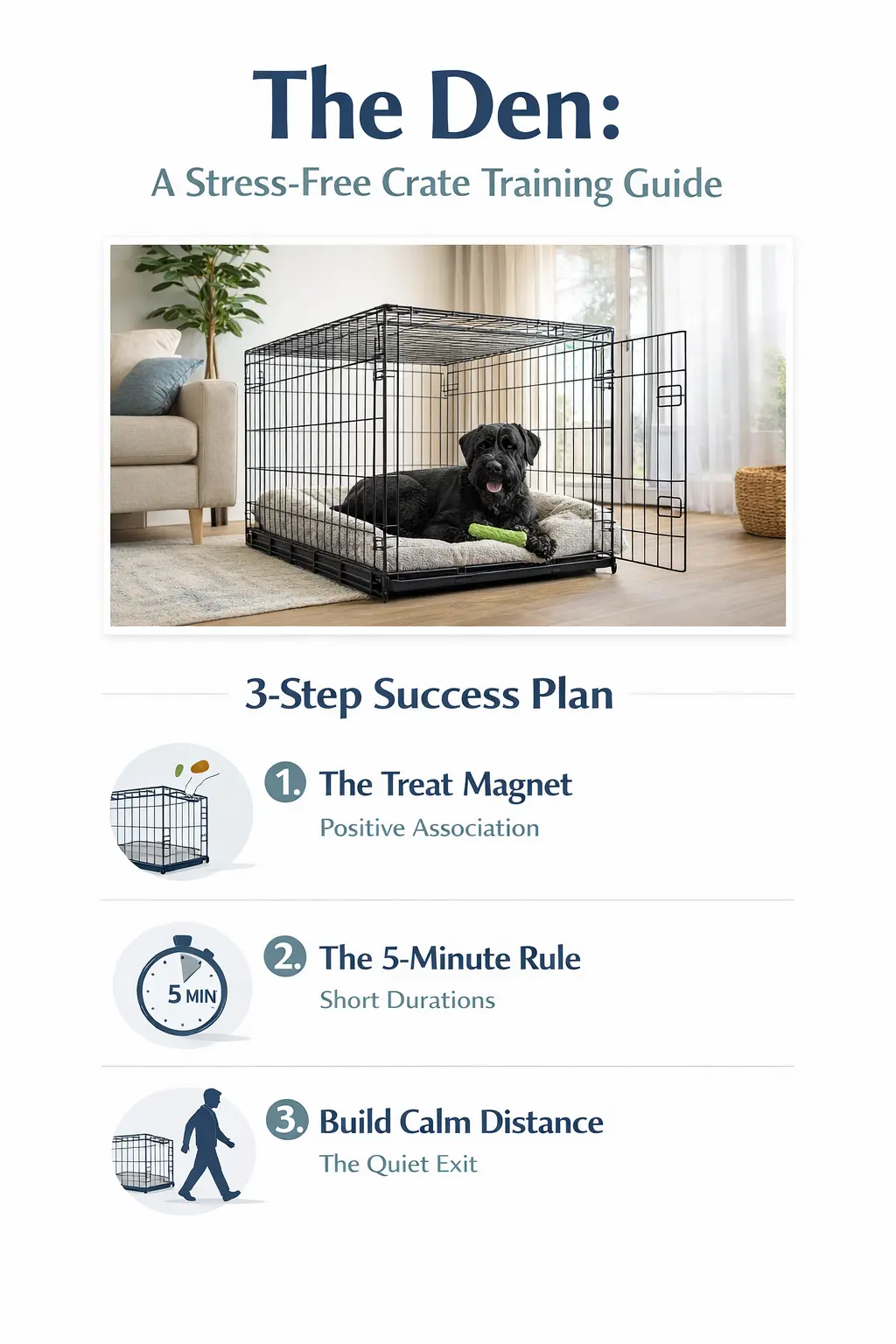
A crate, done well, becomes a dog's own safe resting place — somewhere they choose to settle, not somewhere they're shut away. Done poorly, it can create real distress. This guide walks through a gradual, reward-based introduction based on RSPCA Australia and AVSAB guidance, plus how to troubleshoot whining, regression, and when a crate isn't the right tool at all.
The core principle: the crate is a positive space the dog learns to enter voluntarily — never punishment, never a way to shut a dog away for long periods, and never a way to force a frightened dog to "get used to it."
Crate Size and Setup
Your dog should be able to stand normally, turn around, and lie down comfortably — no cramped confinement, but also no need to oversize a crate for toilet-training purposes. Add comfortable bedding where appropriate, place it somewhere safe and part of normal household life, and start with the door open. From the very beginning, treats, food and toys should be associated with going in.
The Step-by-Step Introduction
Make the Crate Inviting
Door open, bedding in, treats scattered inside. Let your dog investigate on their own terms — no pressure, no closing the door on the first entry.
Voluntary Entry
Toss a treat inside, feed meals near or in the crate, reward any interest or entry, and always let the dog leave again freely. Never force or push a dog in.
Brief Door Closure
Once entry is relaxed and confident, close the door briefly, stay nearby, and reward calm behaviour — reopening before distress sets in where possible. Build duration gradually and let your individual dog set the pace, not a fixed timetable.
Increase Distance
Once short closed-door periods are comfortable, move around the room, then briefly step out of sight, returning calmly. Keep departures and returns low-key rather than dramatic, and extend absences gradually.
Real-World Use
Only once your dog is genuinely comfortable should the crate be used for longer practical periods — sleeping, brief unsupervised time, travel, or vet-advised recovery confinement. Don't jump from seconds of training straight to hours of confinement.
Puppies and Toileting
There's no single rule (like "age in months plus one") that reliably predicts how long any given puppy can hold on — toilet capacity depends on age, the individual puppy, whether they're asleep or active, recent meals and water, health, and activity level. Give frequent toilet opportunities, particularly after waking, after meals, after play, before crating, and promptly after release.
Crates can help with toilet training because many dogs prefer not to toilet where they sleep — but the crate must never be used to force a puppy to hold on beyond what's reasonable for their age and bladder. Accidents happen during training and are never a reason for punishment.
Whining and Barking: Protest vs. Panic
Don't simply "ignore all crying until the dog gives up" — but also don't assume every sound means the same thing. Mild protest looks like a brief vocalisation when the door closes, or a dog who'd rather be with you — it usually settles quickly on its own.
Genuine distress looks different: escalating frantic barking or howling, intense panting when it isn't hot, excessive drooling, repeated escape attempts, biting or clawing at the crate, inability to settle, panic when you move away, or injuring themselves trying to get out. If you see these signs, the step you're on is too hard — scale back and rebuild more gradually. Prolonged "cry it out" is not appropriate crate training.
Should I Open the Door When My Dog Whines?
Opening the crate once doesn't automatically "reward anxiety" — that's an oversimplification. Aim to train at a level where real distress doesn't occur in the first place. If your dog is mildly impatient but otherwise relaxed, a brief calm pause before opening can help. But if your dog is genuinely panicking or at risk of injuring themselves, welfare comes first — let them out safely and reassess your training plan. Never keep a panicking dog confined purely to avoid "reinforcing" the behaviour.
When Crate Training Goes Backwards
Regression can follow a house move, illness, a change in routine, a frightening event, a long gap without crate use, adolescence, a stressful vet stay, or changes in the household. If a previously comfortable dog suddenly struggles, reduce duration and difficulty, rebuild positive associations from an earlier stage, check for environmental changes, and consider pain or illness if the change was sudden. A sudden, significant behaviour change is worth a vet visit.
Adult and Rescue Dogs
Crate training isn't just for puppies — adult and rescue dogs can learn it successfully too, though their prior experiences are often unknown. Some may carry previous confinement trauma, shelter-related stress, or separation-related distress. Progress at that individual dog's pace, and don't assume hesitation is "stubbornness."
A Crate Is Not a Treatment for Separation Anxiety
This is important: a crate does not treat separation anxiety, and for some dogs with separation-related distress, confinement can make panic worse, not better. If your dog shows severe distress when left alone or confined, the answer isn't a stronger crate — it's veterinary assessment and qualified, reward-based behavioural support. Pairing solid alone-time structure with crate use (where appropriate) is covered in our Home Alone Blueprint.
Crate Safety
Check whether collars, tags or harnesses could snag on crate bars, and consider removing snag-prone equipment during unsupervised crating — balanced against your dog's identification needs. Also make sure the crate is well-ventilated, out of direct sun, and never left in a hot garage, car, or unshaded room. In much of Australia this matters year-round, not just in the tropics. Confirm the crate can't tip, and choose bedding and toys suited to that individual dog.
Where to Put the Crate
Most dogs cope better with the crate in a normal household area at first, rather than somewhere isolated. For overnight puppy training, placing it near the owner initially can help with settling and with hearing when a toilet break is needed — you can move it later as your dog matures. There's no single correct location for every dog.
How Long Can a Dog Stay in a Crate?
There's no single universal maximum that applies to every dog — appropriate duration depends on age, toilet needs, health, temperament, prior crate training, time of day, whether the dog is asleep, and total daily time already spent crated. A crate should never replace exercise, toileting, social interaction, enrichment or normal movement, and a long working day isn't solved by leaving a dog crated for the whole shift.
Overnight crating is comfortable for many well-trained dogs, but puppies may still need toilet breaks. Learn to tell the difference between restlessness that signals a genuine toilet need, normal repositioning, and distress — and never ignore a young puppy who genuinely needs to go.
Treats, Chews and Enrichment
Food helps build a positive association — part of a normal meal, a suitable food-enrichment toy, or a safe chew for that dog all work well. Only leave a chew or toy unattended if you're confident it's safe for that dog to have without supervision — consider choking and destruction risk first.
Common Mistakes
- Forcing the dog into the crate
- Using the crate as punishment
- Progressing too quickly through the stages
- Crating for excessive periods
- Only ever using the crate when the owner leaves
- Ignoring genuine panic rather than scaling back
- Failing to meet a puppy's toilet needs
- Expecting a puppy to manage like an adult dog
- Making every release from the crate highly exciting, which can build anticipation and frustration
Is a Crate Right for Your Household?
Crates can be genuinely useful — as a safe rest area, for puppy management, toilet-training support, travel and vet stays, and even emergency evacuation. But a crate isn't mandatory for every dog or household; puppy pens, gated rooms, and other safe confinement areas can work just as well, depending on the dog and the situation.
Max is a Giant Schnauzer, so his crate is a large, open-wire style rather than a solid plastic travel crate — the wire design allows airflow from all sides, which matters in warm weather anywhere in Australia, not just the tropics. The right crate style and size will look different for a small breed or a nervous rescue dog.
Sources & Further Reading
- RSPCA Victoria — Crate Training Your Dog
- AVSAB — Position Statements on Humane, Reward-Based Training
This guide has not been reviewed by a veterinarian or veterinary behaviourist and is not a substitute for individual professional advice, particularly for dogs showing signs of anxiety or distress.