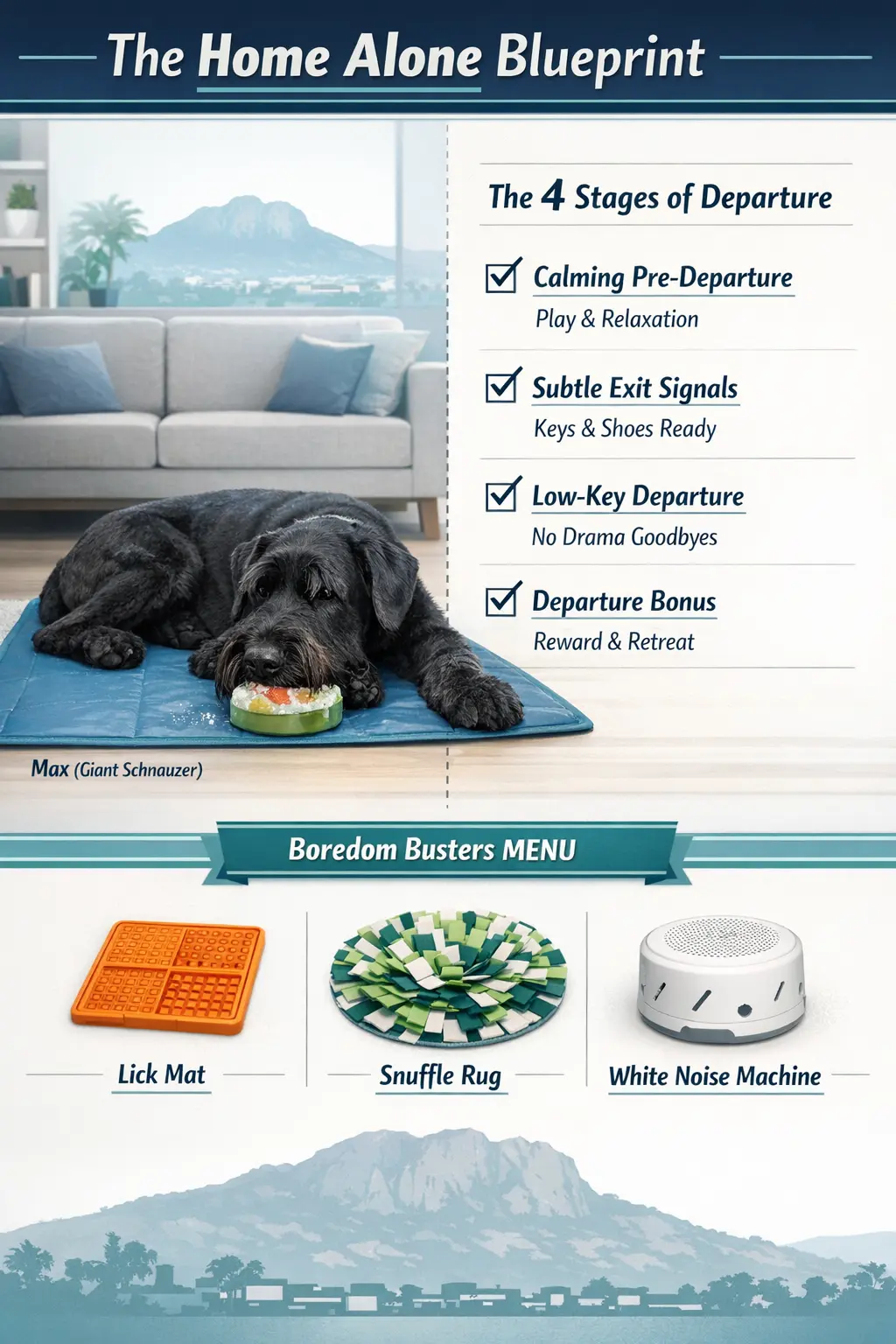
Coping with being left alone is a skill most dogs need to learn gradually — it isn't something every dog does calmly by default, and it isn't just a matter of luck. This blueprint breaks the "event" of leaving down into manageable, non-scary pieces, and covers how to tell ordinary boredom apart from genuine separation-related distress, since they need very different responses.
The 4-Stage Departure Routine
Building Up Absence Gradually
Start with very short absences your dog can genuinely cope with — sometimes just seconds — and return before distress has a chance to build, rather than waiting to see what happens. Increase duration gradually based on how your dog is actually coping, not a fixed timetable, and vary your departure cues so no single one becomes a reliable predictor of a long absence. Keep departures and returns low-key throughout. Don't use a "cry it out" approach — deliberately leaving a panicking dog for longer to "build independence" tends to entrench distress rather than resolve it. A dog already showing distress usually needs a slower plan and smaller steps, not a longer one.
Boredom vs. Genuine Separation-Related Distress
Not every difficult alone-time behaviour means the same thing, and they call for different responses.
More Consistent With Boredom or Unmet Needs
- Chewing inappropriate items
- General restlessness
- Attention-seeking after you return
- Destructive behaviour that doesn't look panic-driven
More Consistent With Separation-Related Distress
- Panic that begins soon after you leave
- Repeated escape attempts
- Intense, persistent vocalisation
- Drooling or panting unrelated to heat
- Self-injury
Not every destructive or noisy dog is in genuine distress, and not every quiet dog is coping well — read the pattern rather than a single moment. Other warning signs worth taking seriously include persistent or howling barking rather than brief protest, frantic pacing, scratching or biting at doors and windows, toileting despite otherwise reliable house-training, refusing food while alone, and an inability to settle at all during the absence. No single sign confirms genuine separation-related distress on its own — but where several of these appear together, or consistently, that pattern deserves a more careful behaviour or veterinary assessment rather than more departure-routine tweaking.
Enrichment & White Noise for Alone Time
Provide one or two appropriate enrichment options before you leave — a lick mat, a snuffle-style mat, or a similar calm activity all work well as part of the departure routine. For detailed ideas on lick mats, sniffing games, puzzle feeders and matching enrichment to your own dog, see Dog Enrichment Tools & Activities. A white noise machine can help too, mainly by masking outside triggers like traffic or passersby and giving your dog a consistent background environment — it's a useful management tool, not a treatment for separation anxiety. If your dog benefits from a dedicated quiet retreat to settle in generally, see the Cozy Corner guide for the full setup.
Environment: Heat vs. Anxiety
The room you leave your dog in matters as much as the routine. Heavy panting, restlessness and pacing are textbook signs of separation-related distress — and also textbook signs of a dog that's simply too hot. Before assuming a struggle is purely emotional, rule the environment out first: poor airflow, a room with high indoor temperature, direct sun through the day, or a hot surface with nowhere cool to lie can all produce the same panting-and-pacing picture on their own, and will make any genuine anxiety worse on top of that. Check the room's actual conditions at the time you'd normally be out, put out more than one water bowl in case one gets knocked over, and set fans or air-con ahead of time rather than leaving it to chance.
If you're seeing serious heat signs — collapse, severe weakness, vomiting, or breathing difficulty — that's the Dog Overheating Emergency Protocol, not this guide. For everyday heat prevention, see Tropical Dog Safety: Beating the Heat.
If Storms Make It Worse
If your dog is also unsettled by storms, alone-time training can become harder during severe weather — treat the storm trigger as its own problem rather than assuming the behaviour is simply boredom. See Storm-Bound Boredom Busters for storm-day activities and the Storm Safety Blueprint for the full storm-safety plan.
A Pet Camera Can Help You See What's Happening
A camera won't fix anything on its own, but it's a genuinely useful way to actually see when distress starts, whether your dog settles or stays unsettled, and whether a specific noise or trigger is involved — information that's hard to get any other way once you've left.
When to Seek Help
Get veterinary or qualified, reward-based behavioural help if distress is severe, your dog injures itself, panic occurs consistently rather than occasionally, they can't tolerate even brief absences, their behaviour changes suddenly, or house-soiling or destruction appears alongside other distress signs. Appropriate absence length depends on your dog's age, health, toilet needs, training history and temperament, not a single universal number — young puppies need far more frequent breaks, and a dog already showing distress usually needs a much slower plan. Avoid aversive anti-barking devices; they can suppress the noise without addressing what's driving it, and may add stress on top of an already struggling dog.
Sources & Further Reading
- AVSAB — Position Statements on Humane, Reward-Based Training
- RSPCA Australia — The Deal with Dog Training
This guide has not been reviewed by a veterinarian or veterinary behaviourist and is not a substitute for professional advice for your individual dog. For genuine separation-related distress, seek qualified, reward-based behavioural support.