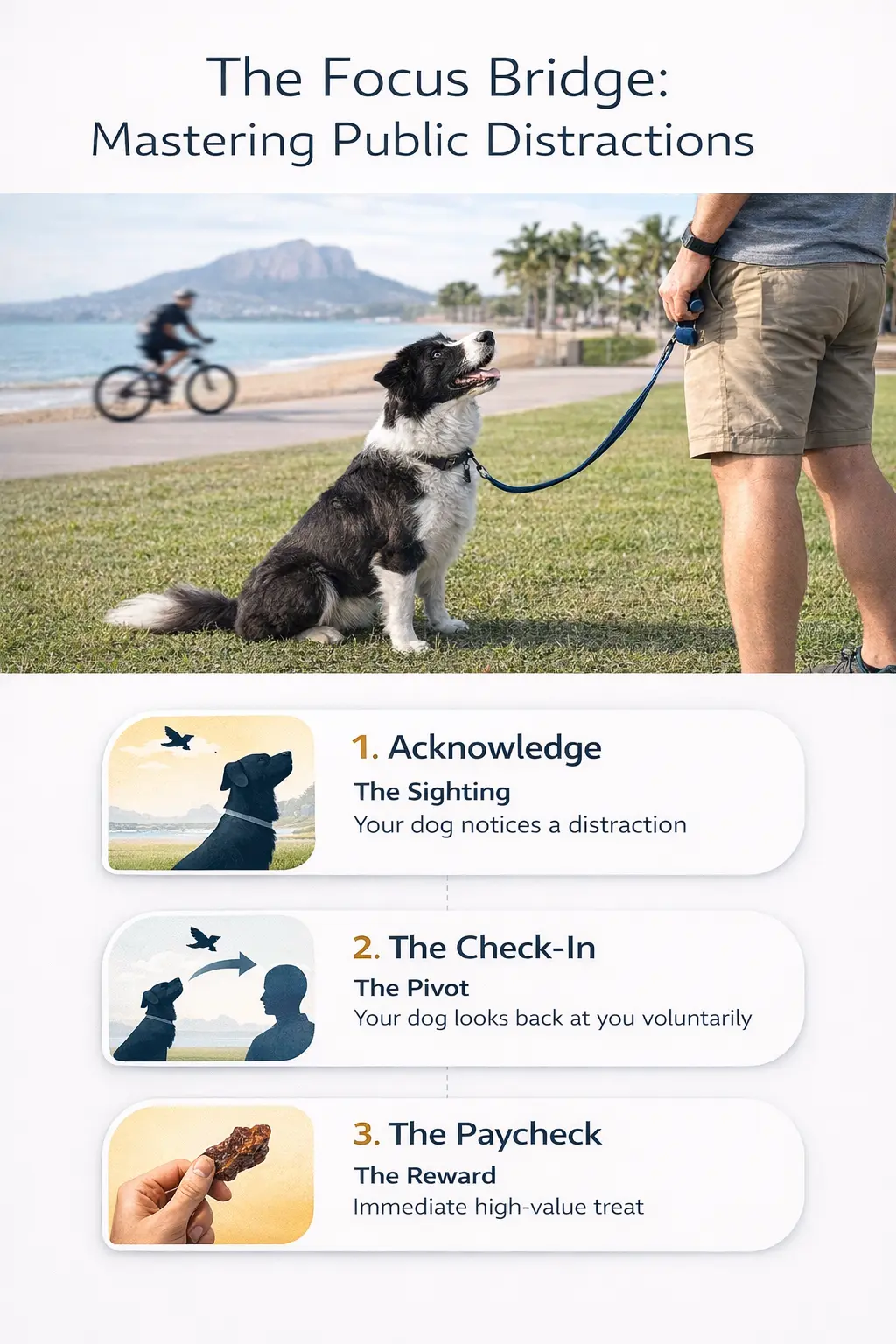
The "Look At That" (LAT) method is a game-changer for high-drive dogs. It turns distractions (bikes, birds, other dogs) into cues for focus. Instead of asking for "blind obedience," we reward the dog for noticing the world and then choosing you.
The 3-Step Process
Acknowledge (The Sighting)
Your dog notices a distraction (a bike, bird, or another dog). We reward the observation, not the reaction. Don't pull the leash—wait for the brain to work.
The Check-In (The Pivot)
The dog voluntarily chooses to look back at the handler. This is the "Focus Bridge" in action. The moment that head turns, mark it!
The Paycheck (The Reward)
Provide an immediate high-value treat (dried liver or jerky) to reinforce the choice of focus over distraction.
If your dog cannot pivot back to you, you are too close to the distraction. Increase the distance immediately to ensure success.
Guarding-Breed Reactivity Isn't the Same as Herding-Breed Reactivity
Most reactive-dog advice is written with motion-chasing herding breeds in mind — a Border Collie fixating on a bike or a jogger. A Giant Schnauzer's reactivity comes from a different place: schnauzers were bred as farm and property guardians, so their trigger isn't movement, it's novelty — an unfamiliar person, dog, or sound approaching what they consider their territory. The goal with a guarding temperament was never to switch off alerting altogether; a dog that never notices anything approaching isn't doing its job. The goal is to shorten the gap between noticing and recovering.
Why Step 2 Matters More for Alert Breeds
For a guarding breed, the "Check-In" step is doing a specific job: it's the dog confirming that you've also clocked the thing it just alerted to. A guard dog that alerts and gets no acknowledgment from its handler will often decide it has to handle the situation itself — which looks like escalating barking or lunging rather than a single alert bark followed by disengagement. Marking and rewarding that check-in teaches the dog that alerting once is enough; you've got it from here.
Practising It at the Fence Line, Not Just on Walks
A herding-driven dog tends to react most to things moving past on a walk. A guarding-driven dog often reacts hardest at the property boundary — the fence line, the front window, the doorbell — because that's the territory it's actually alert to. Run the same three steps there deliberately: let the dog notice a passerby or a delivery at the gate, wait for the check-in, and reward it, rather than only practising LAT on neutral ground where the guarding instinct barely switches on to begin with.
A solid departure routine also reduces how often a guarding breed is left to "patrol" alone in the first place — see the Home Alone Blueprint for pairing this with alone-time structure.