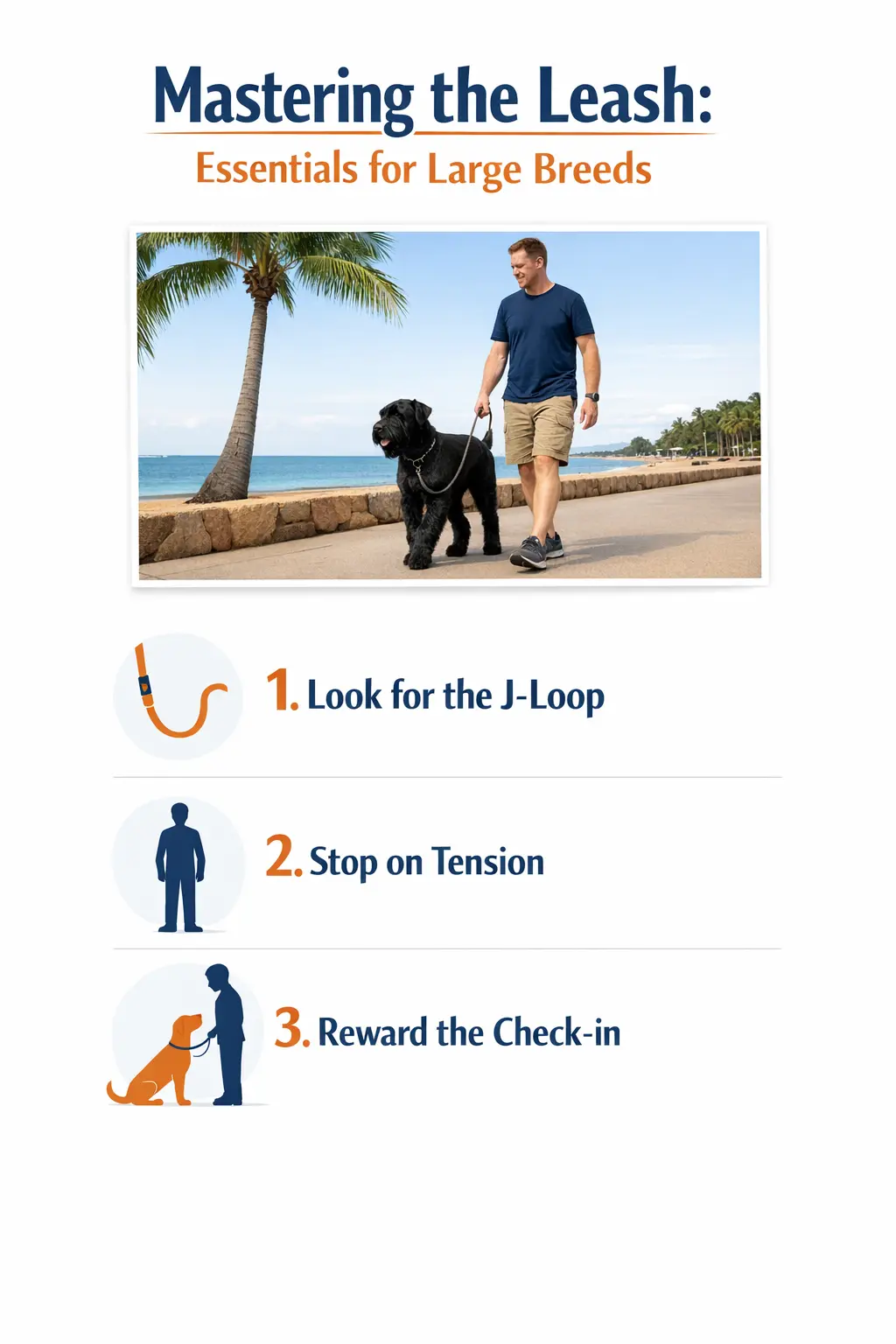
Walking a powerful dog like a Giant Schnauzer shouldn't feel like a wrestling match. This guide breaks down the communication system required for a loose leash. It’s not about strength; it’s about geometry and consistency.
The 3-Step Method
1. Look for the J-Loop
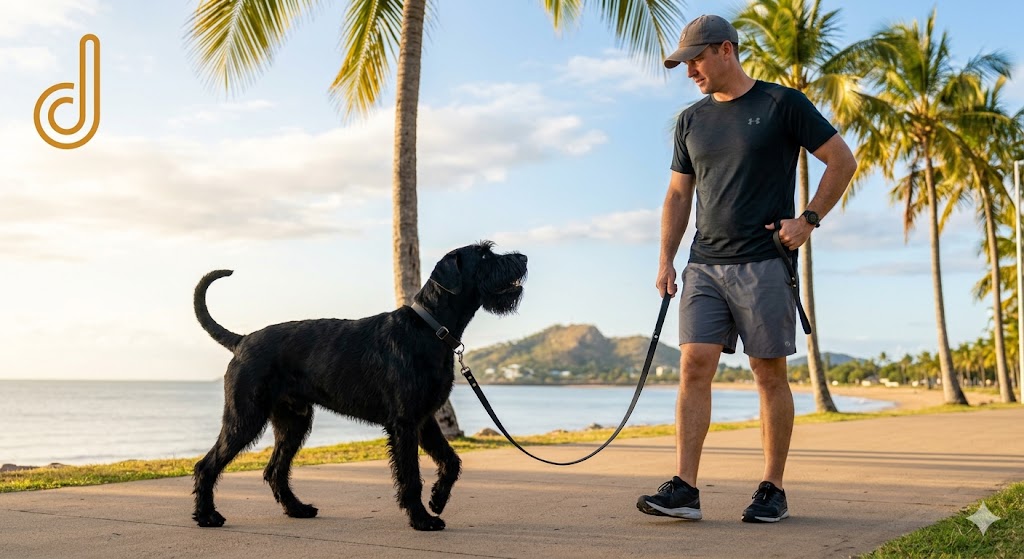
Your primary goal. A relaxed leash should always hang in a 'J' shape. If the 'J' disappears and the line goes straight, the communication has stopped. Your only job is to maintain the 'J'.
2. Stop on Tension
The "Be-a-Tree" method. If the leash goes taut, stop immediately. Do not pull back; simply anchor yourself until the dog realizes the forward motion has ended. Tension = Red Light.
3. Reward the Check-in
The moment your dog looks back at you or moves to slacken the lead, mark the behavior ("Yes!") and reward. You are teaching them that a loose lead is the only way to get where they want to go.
🎯 3-Minute Drills to Stop the Pull
Quick, repeatable exercises you can do on any walk or in the backyard.
Duncan's Cheat Code: The Thumb Anchor
Anchor your thumb to your belt-loop or hip. This creates a hard boundary that doesn't move when the dog pulls. By keeping your hand still, the dog hits a firm but gentle wall the moment the "J" disappears. No wrestling, no sore shoulders — just geometry.
Quick Picks: Gear We Use for Leash Training
Waterproof Biothane Long-Line
Mold-proof, sand-proof, and wipes clean in seconds. The only lead material we trust for Townsville beach training.
Townsville Safety Alert: Heat & Pavement Check
In the QLD heat, a pulling dog is an overheating dog. Straining against a collar increases respiratory distress. If it's too hot for the 5-second back-of-hand test on the pavement, skip the walk and do the Figure-8 drill indoors instead.
🔥 View Tropical Heat Safety Guide →