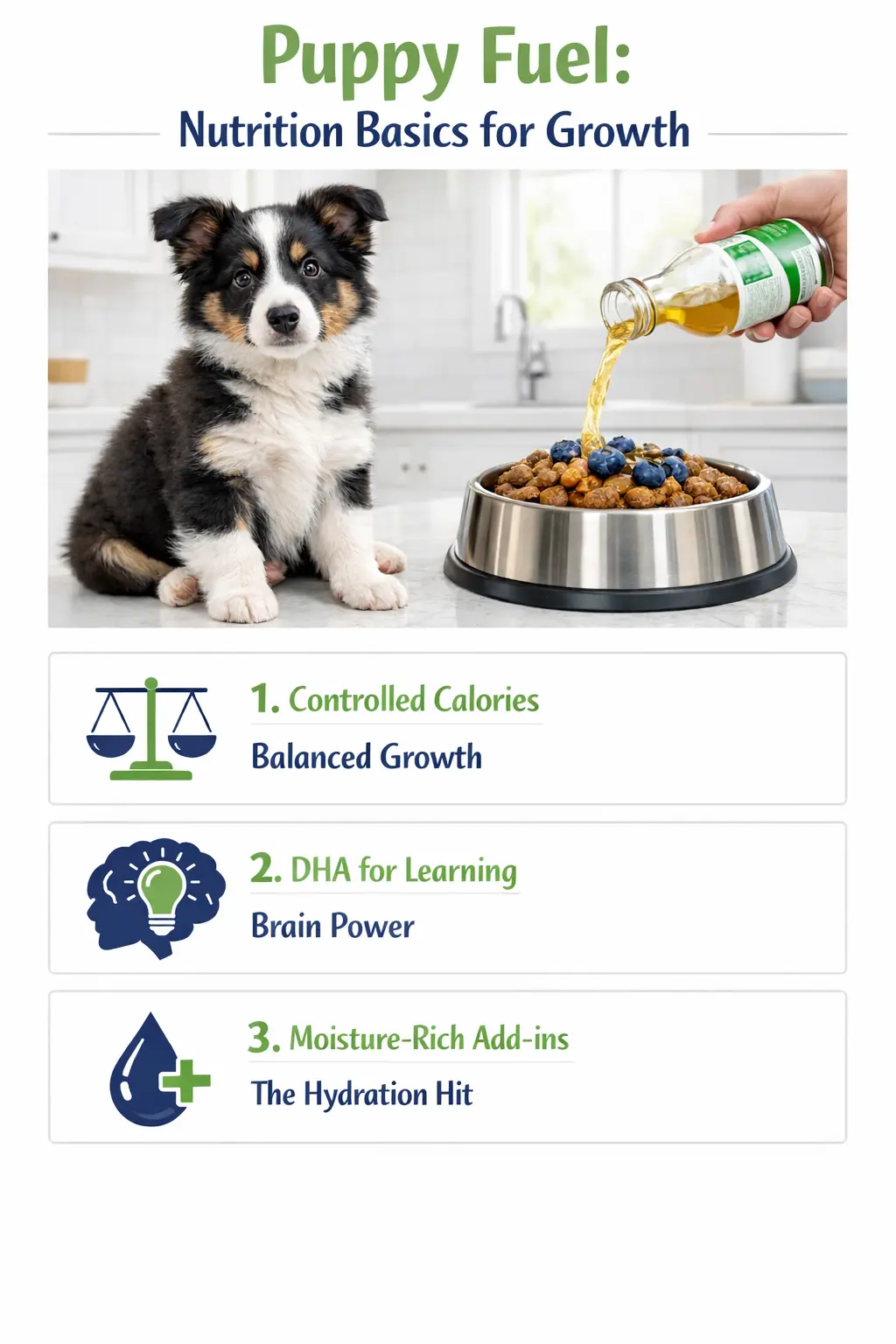
Fueling a high-energy puppy in the Australian climate requires more than just filling a bowl. This guide focuses on the "Big Three" pillars of development: controlled growth for joints, DHA for brain power, and critical hydration.
The 3 Nutrition Pillars
Controlled Calories (Balanced Growth)
Avoid overfeeding to protect developing joints. We aim for a steady, lean growth curve rather than a rapid spike, especially in large breeds (like Max) and high-energy breeds (like Ember).
DHA for Learning (Brain Power)
High-quality Omega-3 fatty acids are the building blocks of a smart dog. DHA supports cognitive function, making early training much easier and faster.
Moisture-Rich Add-ins (The Hydration Hit)
Boost kidney health and digestion by adding bone broth, goat's milk, or warm water to dry kibble. This is essential for puppies growing up in the Townsville heat.
Why a Giant Schnauzer Puppy Isn't Fed Like a Small Breed
A small-breed puppy reaches close to its adult size in around 9–12 months. A large or giant breed — a Giant Schnauzer finishes somewhere around 35–47kg — is often still growing at 12–18 months, with growth plates staying open for longer while it gets there. That longer growth window is exactly why "just feed a puppy food" isn't specific enough advice for a dog this size: too many calories, or too much calcium relative to phosphorus, during that extended rapid-growth phase is linked to a higher risk of developmental joint problems — hip and elbow dysplasia, osteochondritis, and panosteitis among them. A Chihuahua puppy fed the same way faces a completely different risk profile (underfeeding and hypoglycaemia are the bigger concerns there), which is why generic "puppy nutrition" advice that doesn't account for adult size isn't good enough for a large-breed household.
Large-Breed Formula vs. Standard Puppy Food: What's Actually Different
Large-breed puppy formulas are deliberately less calorie-dense per cup and carry a tighter, controlled calcium-to-phosphorus ratio than standard or small-breed formulas — the goal is to slow the growth rate to a steady climb rather than a rapid spike, giving bones and joints time to develop in step with the dog's weight. Before assuming any bag labelled "puppy" is appropriate, check that it's specifically formulated for large-breed growth (most Australian brands say so clearly on the front of the bag) rather than a standard or small-breed formula, which is calorically denser and built for a completely different growth trajectory.
Feed the Dog in Front of You, Not Just the Bag's Chart
Feeding guides on the bag are a starting point, not a rulebook. Check body condition weekly — ribs should be easy to feel under a light layer of fat, with a visible waist tuck from above — and adjust portions up or down to keep a lean, steady growth curve rather than following the chart rigidly regardless of how the dog actually looks. Keeping a large-breed puppy lean through the growth phase is one of the simplest, lowest-cost things an owner can do to reduce the odds of joint problems later in life.
Hydration matters even more once the Townsville heat kicks in — see the Tropical Dog Safety guide for how we manage water intake and cooling once a puppy is old enough for longer days outside.