Dogs can overheat anywhere in Australia when heat, humidity, exercise and a dog's own risk factors combine — not just in the tropics, and not only in summer. This guide is about prevention: understanding what actually drives overheating, spotting rising risk early, and knowing when to stop managing it yourself and switch to emergency care.
🚨 If your dog is already showing serious signs, stop reading this guide.
Weak, confused, staggering, vomiting, collapsing, having difficulty breathing, or showing any other serious sign of heatstroke means it's time to follow the Dog Overheating Emergency Protocol and contact a vet — not to keep reading a prevention page.
How Dogs Actually Cool Themselves
Dogs don't sweat across their bodies the way people do. Their main tool is panting — moving air over the moist surfaces of the mouth, tongue and airway so evaporation carries heat away — with only limited extra heat loss through the paw pads and skin, plus simply moving to somewhere cooler. That's why humidity matters so much: evaporation is what actually removes the heat, and when the surrounding air is already humid, that evaporation slows down, so a panting dog struggles to lose heat even if the air temperature itself isn't extreme. This is a bigger factor in humid regions of northern Australia for more of the year, but it applies anywhere the weather turns humid.
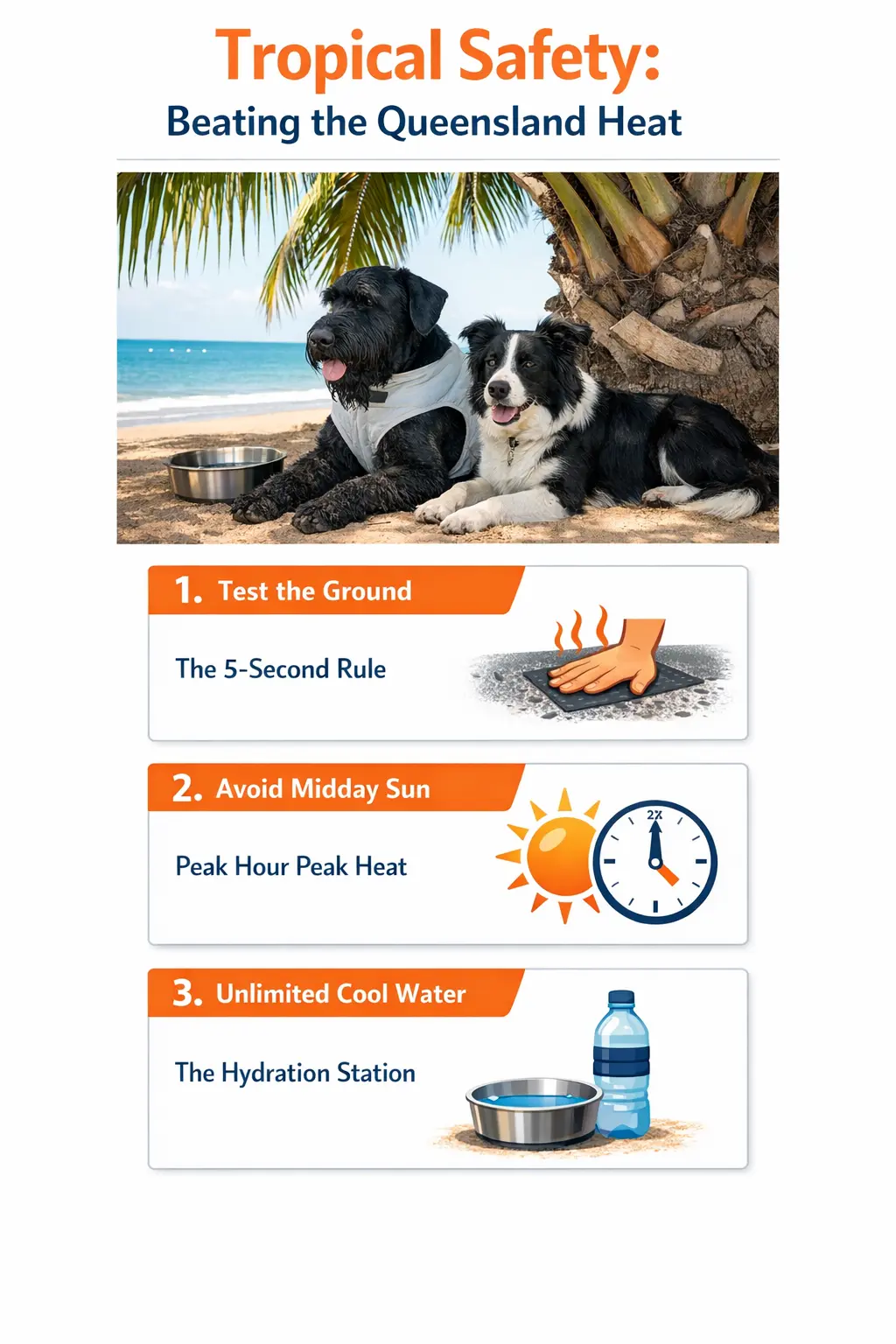
The 3 Survival Rules
The 5-Second Rule
Test the ground with the back of your hand before a walk. If you can't hold it there comfortably for 5 seconds, it's too hot for paws. Treat this as a practical warning check, not a precise safety guarantee — pavement, concrete, artificial turf, metal ute trays, dark decking and beach sand can all get far hotter than the surrounding air, and paw burns are a separate injury from whole-body overheating, even though a hot dog on a hot surface can suffer both at once. When in doubt, stick to grass or wait for cooler hours.
Avoid Midday Walks
Sun intensity, humidity, surface heat and airflow all matter as much as the air temperature on the forecast — there's no single "safe" number that works everywhere, so use judgement rather than a fixed cutoff. As a general rule, exercise earlier or later in the day, shorten or slow down the session when it's hot or humid, pick shaded routes where you can, and stop well before your dog is exhausted rather than pushing to "finish the walk."
Cool Water Always
Carry more water than you think you need on longer walks, keep multiple bowls available at home, use a bowl that won't tip over easily, and refresh water that's gone warm or stale. Good hydration matters, but it isn't a safety guarantee on its own — a dog exercising hard in genuinely dangerous conditions can still overheat even with water on hand.
Fit and Working Dogs Won't Always Stop Themselves
Some dogs — working breeds, ball-obsessed retrievers, running companions, beach dogs, hikers, agility and sport dogs — will keep going even as they become dangerously hot, because drive and enthusiasm can override the instinct to slow down. Don't rely on your dog to choose to stop; you need to be the one making that call, based on the conditions and how the dog is actually coping, not just how keen they seem.
Shade Helps, But Isn't Automatically Safe
A shaded spot can still be dangerously hot if the air temperature or humidity is high and there's little airflow — shade blocks direct sun, but it doesn't guarantee a safe environment on its own. Good ventilation, access to a genuinely cooler surface, and the ability for your dog to move away from a hot spot all matter as much as shade itself.
Which Dogs Are at Greater Risk?
Any dog can overheat, but risk is higher for brachycephalic (flat-faced) breeds, dogs that are overweight or obese, older dogs and puppies, dogs with heart or respiratory disease, dogs with thick or dense coats, dogs with poor fitness, dogs that are already dehydrated, and highly driven dogs that don't self-limit exercise (see above). For thick-coated breeds, that doesn't mean shaving is the answer — coat management varies by breed and coat type, and a double coat often plays a genuine role in insulation and sun protection, so talk to a groomer or vet about what's actually appropriate for your dog's coat rather than defaulting to a shave for summer.
Recognising Rising Heat Stress
Part of prevention is noticing when ordinary panting is turning into something more concerning, so you can stop before it escalates further. Don't wait for severe signs to intervene — early signs are your cue to stop, cool down and reassess, not to keep going and see how it develops.
Early Signs — Stop and Reassess
- Increasingly heavy or relentless panting
- Excessive drooling
- Tongue or gums looking unusually red
- Slowing down or repeatedly seeking shade
- Reluctance to keep going
- Restlessness or reduced responsiveness
Serious Signs — Emergency Protocol Now
- Staggering or poor coordination
- Confusion
- Vomiting or diarrhoea
- Breathing difficulty
- Severe weakness or collapse
- Seizures
Any of the serious signs mean it's time for the Dog Overheating Emergency Protocol, not this page.
Cars, Ute Trays and Enclosed Spaces
Never leave a dog unattended in a parked vehicle in warm weather — cracked windows don't make it safe, and vehicle interiors can heat up dangerously fast. Enclosed sheds and garages can become just as dangerous, and ute trays combine both whole-body heat exposure and hot metal surface risk. See the Dog Overheating Emergency Protocol for what to do if heatstroke is suspected.
Prevention Checklist
- Check the day's heat and humidity, not just the temperature
- Exercise early or late where practical
- Reduce intensity or duration when it's hot or humid
- Carry water, and offer rest breaks
- Choose shaded or cooler routes
- Check the walking surface before you set off
- Watch your dog's behaviour, not just the thermometer
- Know your own dog's individual risk factors
- Know the early warning signs, and act on them
- Know where the nearest vet or emergency clinic is, especially when travelling
Travelling to a Hotter Part of Australia
A dog used to a cooler climate can struggle when travelling into tropical northern Australia, inland heat, or coastal conditions that are hotter or more humid than home. Don't assume your dog's normal routine transfers safely — dial back exercise intensity and duration until you know how they cope with the new conditions. Our National Dog Travel Checklist covers region-specific hazards worth checking before a trip.
Sources & Further Reading
Medical information checked against Australian veterinary and animal-welfare sources including:
- RSPCA NSW — Heat Stress
- Greencross Vets Australia — Heat Stroke & Stress in Dogs
- Animal Emergency Service Australia — Heat Stroke in Dogs
This guide has not been reviewed by a veterinarian and is not a substitute for professional veterinary advice for your individual dog. For suspected heatstroke, use the Dog Overheating Emergency Protocol and contact a vet immediately.
Training in the heat often means dawn or dusk — peak Cane Toad time.
Know what to do if your dog mouths a toad during an early morning walk.
See the Cane Toad Emergency Guide →Related heat, water and weather safety guides: