The 2026 Queensland Dog Law Guide
State Law vs. Council Rules
Queensland sets the state-wide framework — registration, microchipping, effective control and regulated dogs all come from state legislation. But local councils administer dog registration and can add their own local rules on top, covering things like permits, the number of dogs you can keep, off-leash areas, nuisance complaints, waste rules and registration fees. This guide covers the state framework and flags clearly wherever something is a council matter — always check your own council's website for the local detail.
This guide covers Queensland only. Other Australian states and territories have different dog-control laws.
Dog Registration
Dogs must be registered with the relevant local council. Registration is separate from microchipping — you need both. Fees, renewal periods and how registration is administered vary by council, so there's no single statewide fee to quote here. Some categories of working dog may be exempt or receive a concession — check with your local council. If you move to a new council area, you must register (or update your registration) with the new council within 14 days.
Microchipping
Microchipping is mandatory in Queensland and is not the same requirement as council registration. Dogs being sold or given away must be microchipped between 8 and 12 weeks of age by the person selling or giving them away. Keep your contact details on the microchip registry current — this matters even more if you move house or move council areas.
Is Desexing Mandatory?
No — desexing is not mandatory for most Queensland dogs, though it's generally recommended for pets not being kept for breeding. Some local councils impose their own additional requirements, so check yours. The one clear exception: a declared dangerous dog must generally be desexed within a set period after the declaration, subject to a limited exception where a vet certifies it would pose a serious health risk.
If Your Dog Has Puppies
If your dog has a litter, current Queensland guidance says you generally need to register as a dog breeder — within 28 days of the litter being born — unless you qualify for an exemption. Breeders must meet Queensland's animal welfare standards for breeding dogs and litters, and a dog that's been declared dangerous cannot be bred. If you're advertising, selling or transferring puppies, check the Queensland Government's current guidance on breeder identification requirements rather than assuming — the detail here can change.
Regulated Dogs: Dangerous, Menacing & Restricted Breeds
"Regulated dog" is an umbrella term covering three different things, and they're not interchangeable: a restricted breed (a breed banned from import into Australia — currently the Dogo Argentino, Fila Brasileiro, Japanese Tosa, American pit bull terrier/pit bull terrier, and Perro de Presa Canario/Presa Canario), a declared dangerous dog, and a declared menacing dog. Councils can declare a dog dangerous or menacing if it has attacked, or acted in a way that caused fear to a person or animal, or is assessed as likely to.
Owners of regulated dogs generally must microchip and register the dog, keep it in a council-approved, child-proof enclosure with warning signage at each entrance, keep it under stricter control away from the registered address, and fit a distinctive collar (a standardised red-and-yellow angled-stripe design has applied since 1 January 2022). Muzzling in public applies to declared dangerous dogs, not menacing dogs. We're summarising the general framework here rather than every technical condition — see the Queensland Government's Regulated dogs page for the current full requirements for your dog's specific status.
Effective Control
Under the Animal Management (Cats and Dogs) Act 2008, a person in charge of a dog in a public place must, without reasonable excuse, keep it under "effective control." What counts as effective control depends on where you are: in a designated off-leash area, reliable voice control can be enough for an ordinary dog; in any other public place, that generally means physical restraint — a leash or an appropriate tether, with limited exceptions (for example, a dog secured in a vehicle, or a working dog actually performing a working-dog function). A regulated dog does not get the voice-control option — it must be physically restrained even in an off-leash area. Local councils designate which areas are off-leash, so check your council for the areas you actually use.
Practical Compliance Check
- ☐ In an off-leash area, does your dog reliably come back on voice command — not eventually, reliably?
- ☐ Anywhere else in public (footpaths, car parks, playgrounds), is your dog on a leash or appropriate tether?
- ☐ Are you physically able to restrain your dog if it lunges?
- ☐ If your dog is a regulated dog, is it physically restrained even in an off-leash area?
A "no" to any of these is worth addressing before your next walk — councils can issue infringements for non-compliance, and amounts are set locally, not by this guide.
Dog Attacks & Owner Duties
A person in charge of a dog has a legal duty to take reasonable steps to stop it attacking, or acting in a way that causes fear to, a person or another animal — the dog doesn't have to actually bite for this duty to be relevant; causing fear is enough. The Act sets maximum penalties in penalty units (not dollars, since the dollar value of a penalty unit can change) that scale steeply with the seriousness of the outcome, whether the dog is a regulated dog, and whether the owner has a prior serious dog offence — from a base-level penalty for non-compliance, up to several hundred penalty units, with imprisonment available for the most serious cases involving death or grievous bodily harm to a person. Maximum penalties depend on the seriousness of the incident and the relevant offence — a court decides the actual penalty in any real case, and this isn't the automatic fine for every breach. See the current Act or your council for specifics rather than treating any single figure here as universal.
Building Reliable Control
Whatever the legal detail, a dog that reliably comes back and settles around distractions is easier to keep compliant and safe. Two of our training guides are built specifically for this:
Off-Leash Areas, Beaches & National Parks
Off-leash areas are designated by individual councils, not by state law, and usually still require effective control (recall and appropriate behaviour), not unlimited freedom. Beach access is likewise mostly a council matter — some beaches are on-leash, some are off-leash in designated sections, and some prohibit dogs entirely; check your council's current signage rather than assuming. Dogs are generally prohibited from national parks and most areas managed by Queensland Parks and Wildlife Service, with limited exceptions in some state forests and recreation areas — see Queensland Parks and Wildlife Service — Dogs and pets before you plan a trip.
Waste, Barking & Number of Dogs
These are council/local-law matters, and requirements genuinely differ across Queensland. Most councils require owners to pick up dog waste in public places — Brisbane, for example, requires people walking a dog to carry waste bags under its own local law, but that's a Brisbane rule, not a Queensland-wide one. Excessive barking may lead to a council complaint and investigation, but the thresholds and process are set locally, not by a statewide standard. The number of dogs you can keep without a permit, and any property conditions that apply, are also council-set — check your local council before adding another dog to the household rather than assuming a number that applies elsewhere.
Renting With a Dog
Queensland tenancy law no longer allows a blanket "no pets" clause — approval is meant to be considered on reasonable grounds rather than refused outright, and a working dog generally doesn't need approval the way an ordinary pet does. This is a simplified summary of a more detailed area of law — see the Residential Tenancies Authority — Renting with pets for the current detail rather than relying on this page for a tenancy dispute.
Animal Welfare
Separately from the dog-control rules above, all Queensland pet owners have a duty to provide appropriate care under the Animal Care and Protection Act 2001. This guide is about dog-control law, not a full welfare guide — the Queensland Government's own pet-laws page is the place to start if you want the plain-language welfare obligations.
Moving Between Councils
Moving to a different Queensland local government area can affect your registration — current guidance requires registration with the new council within 14 days of the move. It's also a good moment to update your contact details on the microchip registry, since that's a separate system from council registration and won't update itself.
Assistance & Working Dogs
Some categories of working dog may have registration exemptions or concessions — ask your local council rather than assuming one applies. Recognised assistance dogs are a distinct legal category from ordinary companion dogs and carry their own rights of access under separate legislation; that's a large area in its own right and outside the scope of this guide.
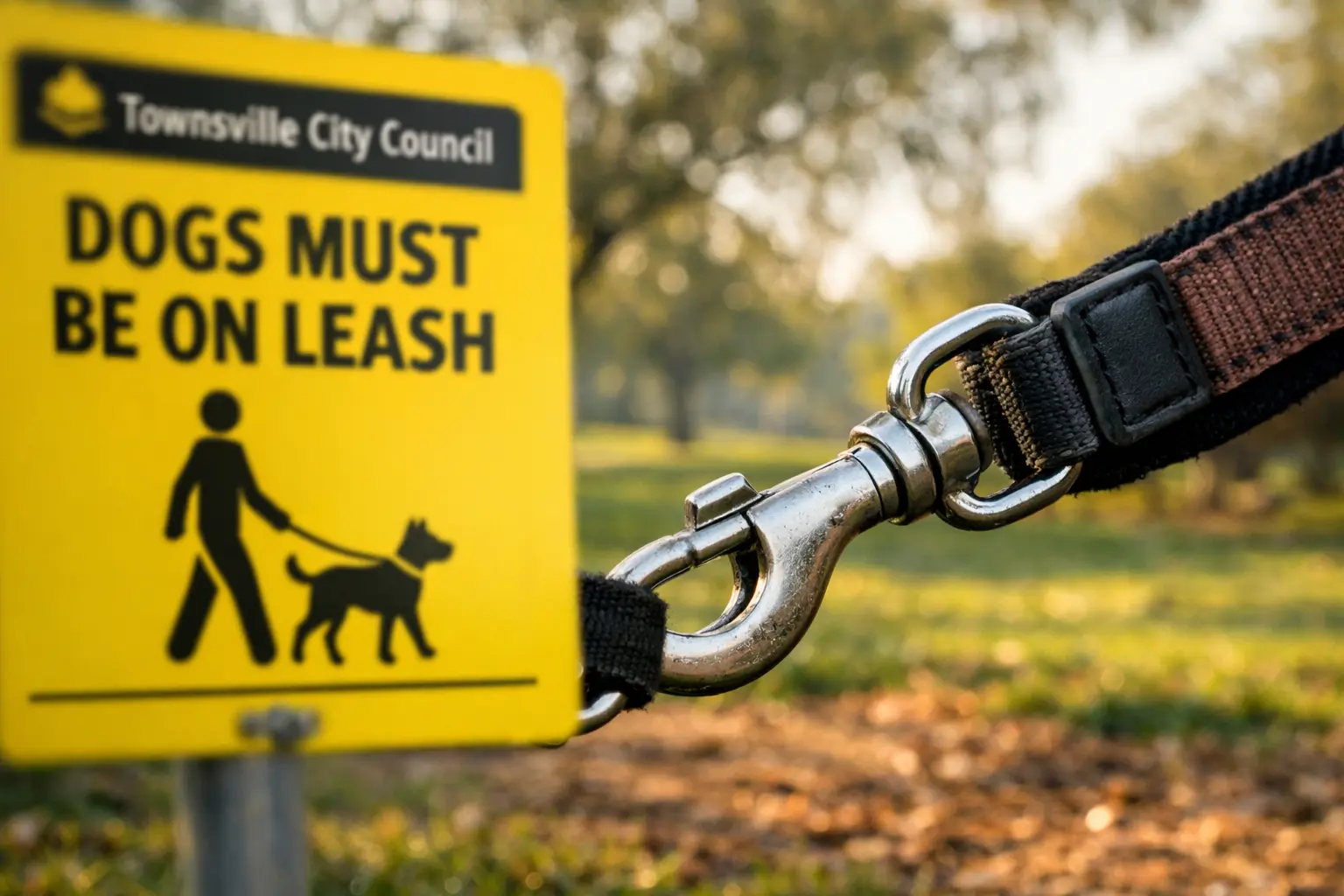
A Townsville City Council on-leash sign — shown as one real example of council signage. Wording, leash requirements and off-leash areas vary by council, so treat this as illustrative rather than representative of every Queensland council.
Sources & Further Reading
- Queensland Government — Laws for pet owners in Queensland (checked August 2026; page states it was last updated 9 July 2026)
- Queensland Government — Regulated dogs
- Animal Management (Cats and Dogs) Act 2008 (current reprint)
- Queensland Parks and Wildlife Service — Dogs and pets
- Residential Tenancies Authority — Renting with pets
Last legal-content review: August 2026. This guide is general information, not legal advice. Laws, local rules, fees and penalties can change. Check the Queensland Government and your local council for the current requirements that apply to you.