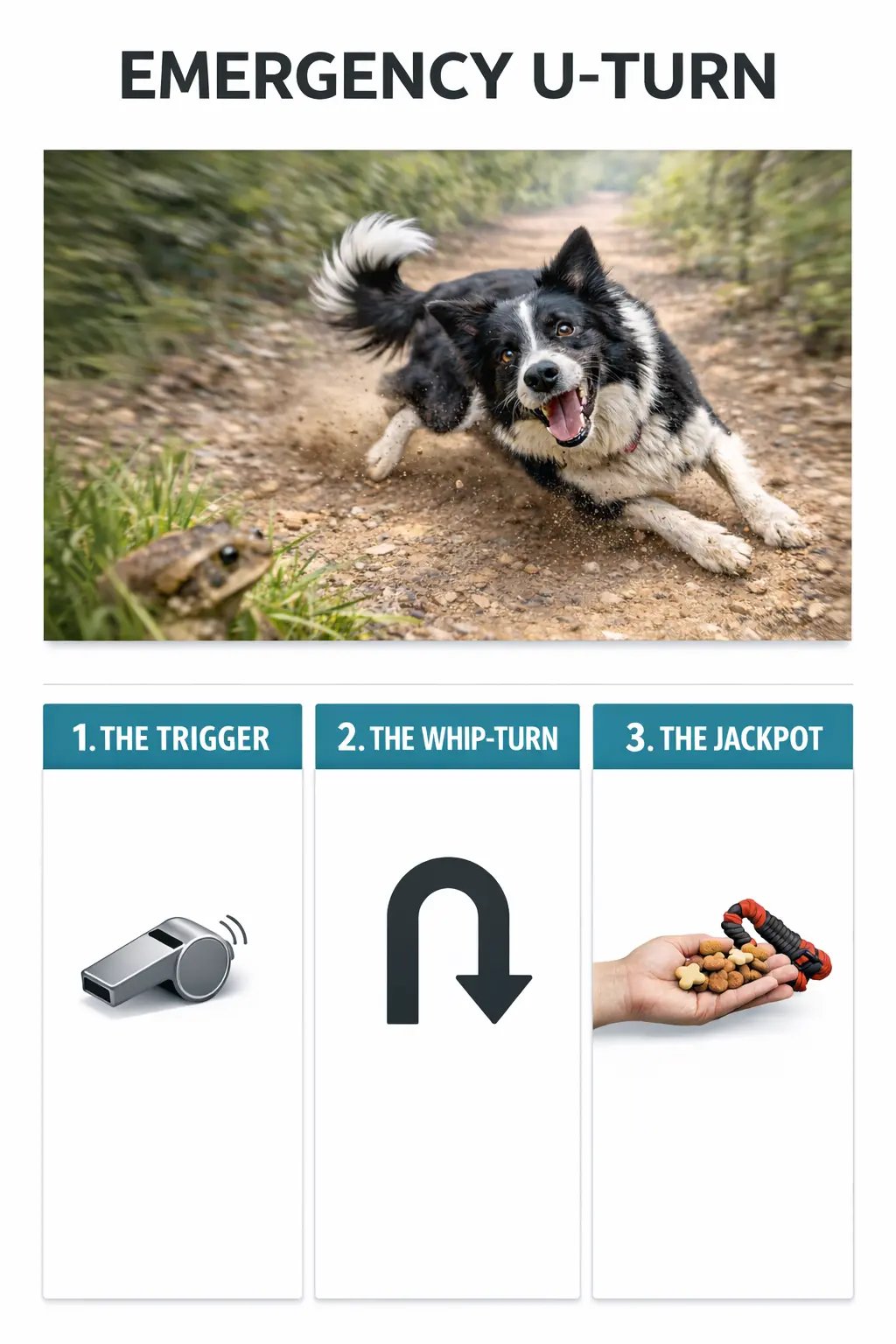
An emergency U-turn is a trained movement pattern for one specific situation: something ahead makes continuing forward the wrong choice, and the safest option is to leave immediately. On cue, your dog disengages from whatever's ahead, turns with you, and moves away quickly — before curiosity, fixation or arousal has a chance to take over.
It's useful around loose or rushing dogs, snakes, cane toads, wildlife, aggressive or highly aroused dogs, unsafe traffic, livestock, or simply a dog fixating on something ahead. It isn't a replacement for recall, good leash handling, situational awareness, veterinary emergency care, or professional behaviour support — it's one practical escape skill that complements all of those.
What the Finished Behaviour Looks Like
On the cue: your dog hears the signal, immediately turns away from what's ahead, turns with you, follows quickly in the opposite direction, and gets reinforced once moving safely away. Trained well, the cue becomes fast and automatic enough to interrupt attention before fixation sets in. It won't reliably override a dog already in full panic, predatory chase, or extreme aggression — the whole point is to use it before that stage.
Choose a Distinct Cue
Pick something short and clear that you'd never use casually — "This way!", "Turn!", "Let's go!" or similar. There's no single correct word; what matters is a consistent cue, a distinct tone, a practised movement pattern, and a strong reinforcement history behind it. Don't fire off the emergency cue in low-stakes moments just for the sake of practice — overusing it without real reinforcement weakens its meaning.
Building the Skill: Stage by Stage
Teach the Turn, No Distractions
Start somewhere easy — inside, the backyard, a quiet driveway. With your dog beside or slightly ahead of you, give the cue once, immediately turn around, encourage your dog to follow, and reward generously when they catch up. Use obvious body movement to make success easy at this stage. Never jerk the leash to force the turn.
Build Speed and Enthusiasm
Once your dog understands the movement, vary your walking direction, cue unexpectedly, turn briskly, and reserve your best rewards — food, brief play, access to something they value — for the fastest responses. You're building the association: this cue means turn immediately and follow.
Add Distance from Distractions
Practise near mild distractions — another dog far away, a person, a parked bike, wildlife at a safe distance — kept far enough away that your dog can still think and respond. Don't start beside your dog's biggest trigger. If they can't respond, you're too close or the distraction is too intense — make it easier. A failed rep usually means the setup was too hard, not that your dog is being stubborn.
Practise on Real Walks
Once reliable in structured practice, rehearse occasionally on ordinary walks — no emergency needed — to keep the movement fluent. Practise enough to stay sharp, but don't say the cue repeatedly without reinforcing it, and always reward a good response.
Real Emergency Use
Recognise the hazard early, give the cue once, turn immediately, move away decisively, and create as much distance as the situation needs — rewarding once your dog is safe and able to take reinforcement. Don't stand still repeatedly calling the cue while your dog keeps staring at the hazard. Your movement is part of the cue.
Timing Matters
The U-turn works best before your dog reaches full fixation or arousal — not after. Watch for early signs it's time to turn: a sudden freeze, a stiffening body, staring or fixating, ears and body orienting strongly toward something, slowing down while staring, or pulling toward whatever's ahead. If you spot the hazard before your dog does, that's often your best window. Acting early is far easier than trying to recover once a dog has already escalated.
Leash Handling
Keep enough slack for normal movement, and shorten your hold if a hazard appears. Turn with your dog rather than yanking them backwards — the trained cue and your own movement should do the work, not a hard leash correction. Skip leash jerks, choke chains, prong corrections, or any punishment for simply looking at a trigger. For a powerful dog, a well-fitted harness and solid handler footing matter more than any single piece of gear — though that's a separate topic in its own right.
What If My Dog Doesn't Turn?
Common reasons: the distraction was too close, the cue isn't sufficiently trained yet, the reward history is too weak, your dog is already above threshold, you hesitated, or the cue has been used too often without reinforcement.
In the moment: create more distance, physically move away without dragging or punishing, and go back to easier practice later to rebuild speed and reinforcement. Don't repeat the cue louder and louder — that just teaches your dog to ignore the first few repetitions.
Don't "Test" the Dog Near Real Hazards
Never deliberately walk close to an unknown dog, wildlife, a snake, or a reactive dog's trigger just to see whether the cue works. Train at safe distances — the emergency skill exists for hazards that appear unexpectedly, not as an excuse to get closer to one.
Reactive Dogs
An emergency U-turn can be especially useful for dogs who become over-aroused around other dogs, people, bicycles, vehicles or wildlife — but it's not a complete behaviour-modification plan. For dogs with significant reactivity, fear or aggression, pair this skill with qualified, reward-based professional support.
Puppies and Multi-Dog Households
Puppies can learn this as a simple movement game — keep sessions short, upbeat, easy and well rewarded. Don't wait for a real emergency to teach it for the first time.
Walking multiple dogs? Teach the movement to each dog individually where practical — coordinating an emergency turn with several dogs at once is a harder skill than doing it with one.
Practice Frequency
Skip rigid schedules. A few successful, well-rewarded repetitions in a short session beat drilling until your dog loses interest. Reliability builds through repetition, gradually increasing distraction, strong reinforcement, and real-world rehearsal — not volume.
Australian Hazard Examples
Snake: turn and create distance immediately — don't approach or investigate, and don't use the U-turn as an excuse to get a closer look. If a bite is suspected, the Snake Bite Emergency Protocol takes over from here.
Cane toad: where they occur, turn away before your dog mouths or investigates one. If exposure happens anyway, follow the Cane Toad Emergency Guide. Both of these are about avoiding exposure in the first place — not substitutes for emergency treatment if exposure occurs.
How This Differs from Recall
Recall means "come back to me." An emergency U-turn means "we are both changing direction and leaving, right now." Some dogs find the U-turn easier in the moment because the handler moves with them, rather than asking the dog to disengage alone and travel back to a stationary person. The two skills complement each other — see our Rocket Recall guide for the complementary "come back" skill.
How This Differs from Focus/LAT Training
Our Focus Bridge / LAT guide helps a dog notice a trigger and stay under threshold while remaining in the situation. The emergency U-turn is the exit strategy for when staying in the situation is no longer the best choice. Use LAT to manage a dog's attention around known, moderate triggers; use the U-turn when the safest move is to leave.
Common Mistakes
- Teaching it for the first time during a real emergency
- Repeating the cue over and over instead of moving
- Waiting until the dog is fully fixated before acting
- Using leash corrections instead of movement and reinforcement
- Practising too close to real triggers
- Weak or inconsistent rewards
- Changing the cue wording from session to session
- Turning slowly or hesitantly instead of decisively
- Deliberately testing the dog near a real hazard "just to see"
Sources & Further Reading
- RSPCA Australia — The Deal with Dog Training
- AVSAB — Position Statements on Humane, Reward-Based Training
This guide has not been reviewed by a veterinarian or veterinary behaviourist. For dogs with significant reactivity, fear or aggression, seek individual guidance from a qualified reward-based trainer or veterinary behaviourist.