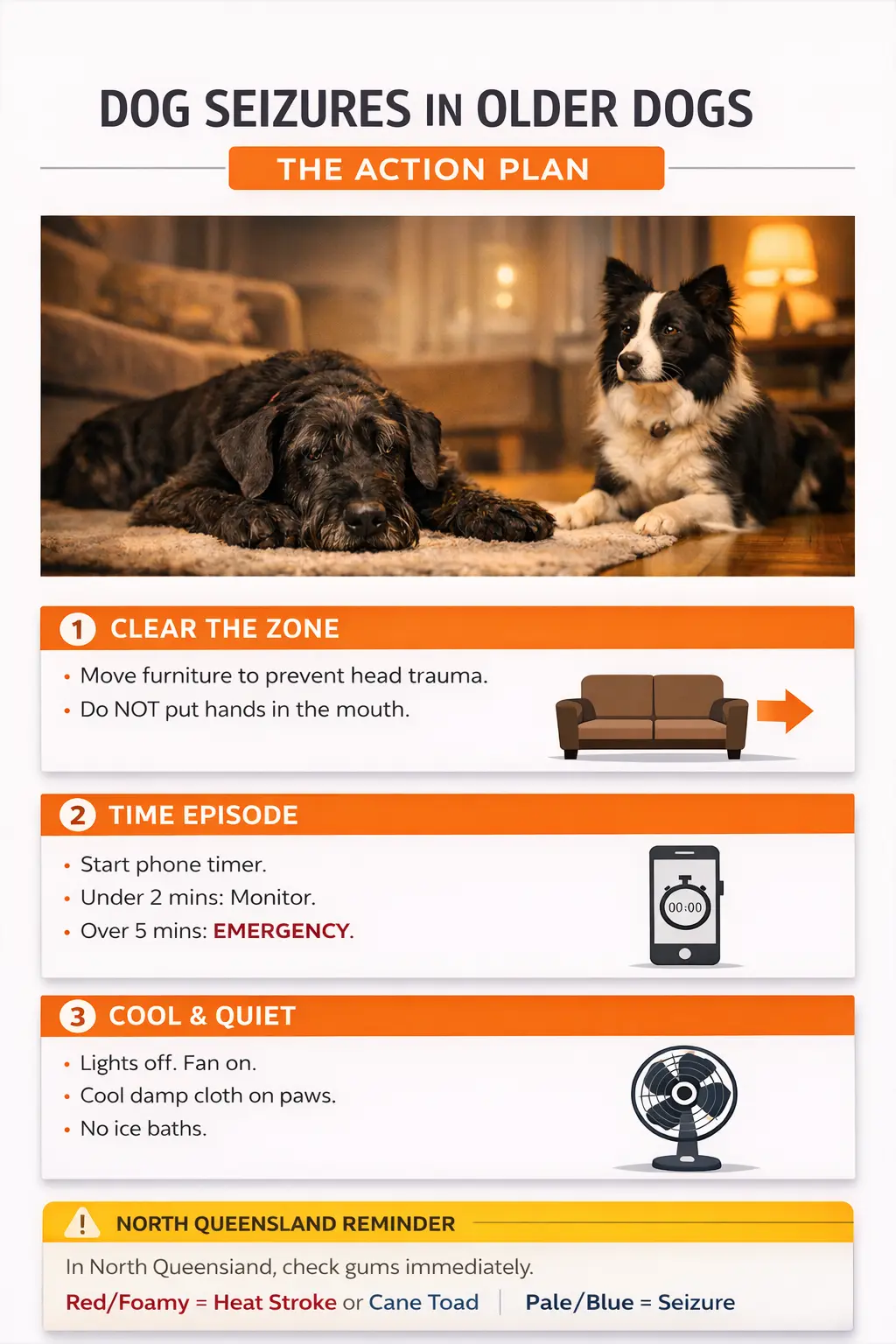
A seizure in an older dog is alarming to watch, but knowing what to do — and what to watch for afterwards — makes a real difference. This guide covers how to keep your dog safe during a seizure, when it's a genuine emergency, and why a new seizure in a senior dog is always worth a proper veterinary look rather than a wait-and-see approach.
This page provides general educational information for Australian dog owners. It does not replace veterinary diagnosis or treatment — if you're ever unsure, contact your vet.
🚨 What should I do while my dog is having a seizure?
During the seizure
- Stay calm.
- Move furniture, objects and other pets away if it's safe to do so.
- Do not restrain your dog.
- Do not put your fingers, hands or any object in your dog's mouth.
- Time the seizure from the moment it starts.
- Record video if you can do it safely — it's genuinely useful for your vet.
When is a dog seizure an emergency?
- The seizure lasts 5 minutes or longer.
- Your dog has repeated (cluster) seizures.
- Your dog doesn't recover normally between seizures.
Any of these — get emergency veterinary care immediately, day or night. Don't wait to see if it passes.
What does a dog seizure actually look like?
Seizures don't always look the same. The most recognisable kind involves sudden collapse, stiffening, and paddling or jerking limbs, often with jaw chomping or other repetitive mouth movements, drooling, and sometimes urination or defecation. Awareness is usually lost or altered during this type of seizure.
Other seizures are subtler. A focal seizure may only involve staring or a brief change in awareness, twitching limited to part of the face or body, or a repetitive, unusual movement — without the dog ever fully collapsing.
Not every twitch, dream-kick, or odd moment is a seizure, so try not to read too much into every unusual movement. But if something genuinely looks off and you're not sure, a video for your vet is far more useful than guessing from memory.
Before, during and after: what's actually happening
Pre-ictal (before)
Some dogs show a behaviour change beforehand — restlessness, clinginess, or seeming "off" — though many show no obvious lead-up at all.
Ictal (the seizure)
The active event itself — anything from a brief focal episode to full-body collapse and paddling.
Post-ictal (after)
The recovery period, which can take anywhere from minutes to longer to fully pass.
Why is my dog confused after a seizure?
It's common for a dog to be confused, disoriented, restless or pacing, and tired once a seizure ends, and some dogs temporarily seem to have trouble seeing properly or behave out of character for a while. A normally easygoing dog can seem frightened or even reactive while still disoriented, so give them space, keep the environment quiet and low-stimulus, and supervise without crowding them until they're clearly back to themselves.
Why would an older dog suddenly start having seizures?
This is the part that matters most for senior dogs. Seizures can have many different underlying causes, and vets generally think about two broad groups: problems arising from outside the brain, and conditions that affect the brain itself. Depending on your dog's history and examination, possible categories include:
- Metabolic disease
- Toxin exposure
- Liver, kidney or other systemic problems
- Inflammatory or infectious neurological disease
- Structural brain disease, including tumours
- Epilepsy — usually diagnosed only once the causes above have been ruled out
None of this is something you can work out from home — only your vet can narrow it down through examination and testing. It also doesn't mean the worst: many of these causes are treatable or manageable once identified, which is exactly why finding the cause matters more than guessing at one.
Does one seizure mean my dog has epilepsy?
Not necessarily — and especially not in a senior dog. Idiopathic epilepsy (seizures with no identifiable underlying cause) typically starts in young dogs, generally between six months and a few years old. A first seizure appearing much later in life is more often linked to one of the other causes above, which is exactly why vets investigate a new seizure in an older dog rather than assuming epilepsy by default.
What might the vet investigate?
Depending on your dog's individual history and what your vet finds on examination, an assessment may include some or all of the following:
- A detailed medical history
- Physical examination
- Neurological examination
- Blood tests
- Urine testing
- Other diagnostic testing as indicated
- Advanced imaging such as MRI or CT, in selected cases
- Possible referral to a veterinary neurologist
Not every senior dog needs every test on this list — your vet will tailor the work-up to your dog's specific history and what the examination suggests.
What should I record after a seizure?
A good description helps your vet enormously — but memory from a stressful event is unreliable, and it's very common for owners to overestimate how long a seizure actually lasted. A minute of paddling limbs can easily feel like five. Timing it with a phone stopwatch, rather than relying on your impression afterwards, gives your vet something they can actually use.
| Field | What to note |
|---|---|
| Date | Date of the episode |
| Start time | When it began |
| Duration | Actually timed, not estimated |
| Before | What your dog was doing beforehand |
| What it looked like | Collapse, stiffening, paddling, twitching, staring, etc. |
| Awareness | Did consciousness seem altered? |
| Toileting | Urination or defecation, if it happened |
| Recovery behaviour | Confusion, pacing, tiredness, etc. |
| Recovery duration | Roughly how long it took to seem normal again |
| Possible exposure | Any chance of a toxin or unusual event beforehand |
| Current medications | Anything your dog is currently taking |
| Video obtained | Yes / No |
Could it be something other than a seizure?
Some events can look similar to a seizure but have a different cause entirely — including fainting (syncope) and vestibular episodes, a balance-system problem that can cause sudden falling, a head tilt, or disorientation. Telling these apart matters for treatment, and it isn't something to work out at home. A video plus a detailed description of exactly what happened is one of the most useful things you can bring your vet to help distinguish between them.
If your dog is already on seizure medication
If your dog has been prescribed anticonvulsant medication, follow your vet's instructions exactly. Don't stop or change the dose suddenly without veterinary advice — doing so can trigger worse seizures in some dogs. If you miss a dose, or the medication doesn't seem to be working as well as it used to, discuss it with your treating vet rather than adjusting anything yourself.
When should I contact the vet?
Emergency now
- The seizure lasts 5 minutes or longer
- Multiple or cluster seizures
- Your dog doesn't recover normally between seizures
- Serious injury, a breathing problem, suspected poisoning, or any other obvious emergency
Prompt veterinary assessment
- First known seizure
- A new seizure in a senior dog
- The seizure pattern has changed
- Seizures are becoming more frequent or severe
- Post-seizure recovery or behaviour is concerning
Suspected poisoning is one of the more common causes of a sudden seizure in Australia and always warrants urgent veterinary contact. If your dog may have mouthed a cane toad, see our Cane Toad Emergency Guide — it also has a directory of 24/7 emergency vet networks across Australia if you need to find one right now. For common household food hazards, see Foods Toxic to Dogs in Australia.
Sources & further reading
Medical information on this page has been checked against veterinary sources including:
- Cornell University College of Veterinary Medicine — Managing Seizures
- Cornell University College of Veterinary Medicine — Idiopathic Epilepsy in Dogs
- MSD Veterinary Manual — Epilepsy in Small Animals
- Greencross Vets Australia — Seizures in Dogs and Cats
- Vet Voice (Australian Veterinary Association) — Epilepsy in Animals
This guide has not been reviewed by a veterinarian; it is written for general education and checked against the sources above. It is not a substitute for professional veterinary advice for your individual dog.