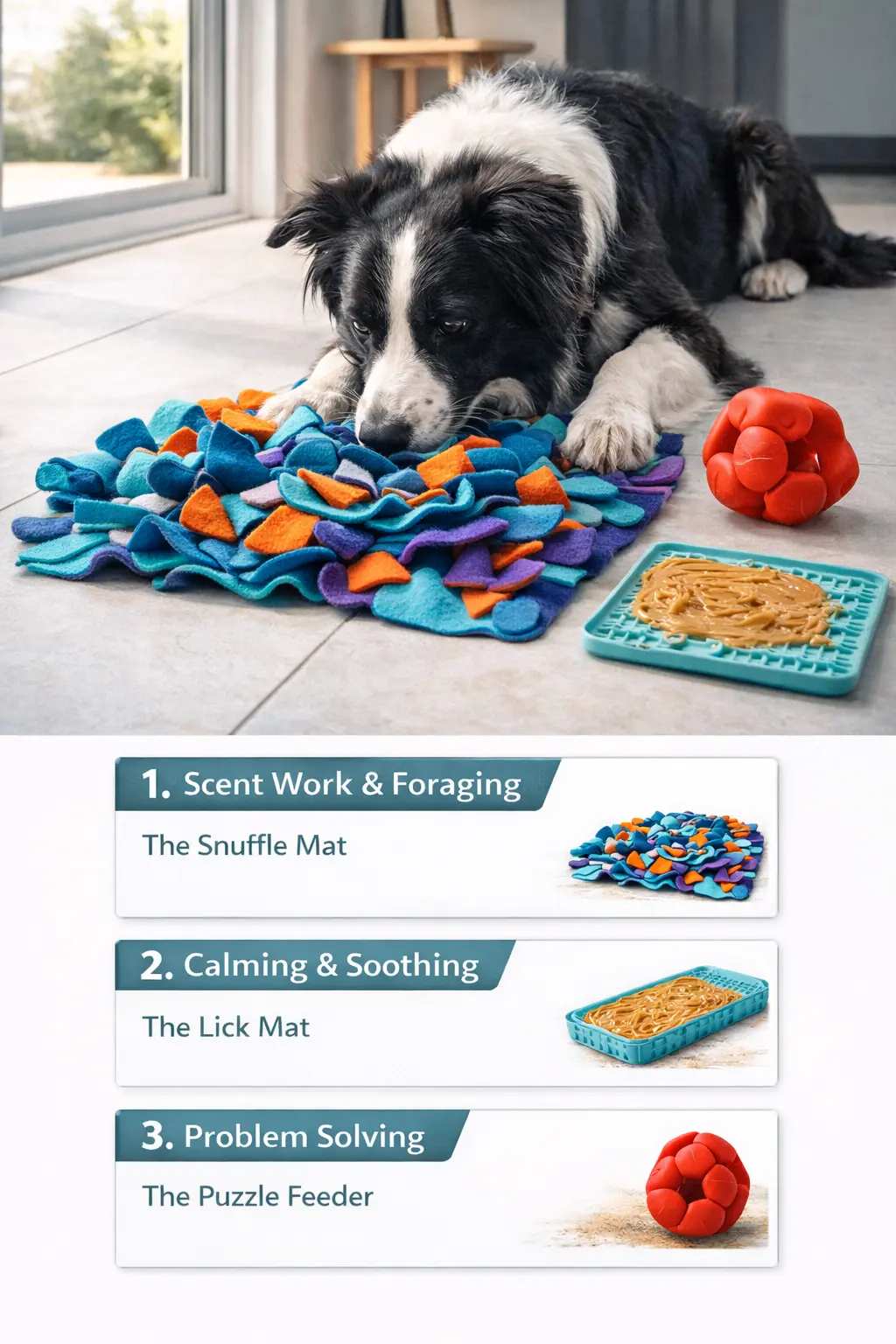
Enrichment means giving a dog opportunities to use their brain and body in ways that matter to them — sniffing, chewing, searching, solving problems — rather than just filling in time. It's useful year-round, for all sorts of reasons: a storm keeping everyone inside, a rest or recovery day, limited outdoor access, apartment living, wet weather, a senior dog who can't do as much physically, or a high-drive dog that needs mental work as much as exercise. Heat is one of those reasons too, but only one of several — this guide isn't a hot-weather workaround, it's a year-round toolkit.
Enrichment Isn't Just About Tiring Your Dog Out
It's tempting to think of enrichment purely as a way to burn energy, but that's only part of it. Good enrichment can offer mental engagement, the chance to sniff and investigate, an element of choice, genuine problem-solving, calm occupation, and the chance to do species-appropriate things like foraging and chewing. The goal isn't always exhaustion — some activities are meant to build engagement and confidence, while others are meant to help a dog settle. Both are valid uses of enrichment, and they're not interchangeable.
Match the Enrichment to Your Dog
Not every dog enjoys the same activity. A useful starting point is thinking about what your dog tends to gravitate toward, then choosing enrichment that fits:
Scent-Driven Dogs
May enjoy sniffing games, scatter feeding, scent trails, "find it" searches and snuffle mats.
Problem-Solvers
May enjoy puzzle feeders, food-dispensing toys and simple search or problem-solving tasks.
Chewers & Dogs That Settle Through Oral Activity
May enjoy safe chews, lick mats and appropriate food-stuffed enrichment.
Working, Herding & Guarding Breeds
May benefit most from activities that give them a job: searching, controlled problem-solving, short training tasks and structured mental effort.
Treat these as starting points, not rules — plenty of dogs enjoy more than one category, and breed tendencies are generalisations, not guarantees. The individual dog in front of you matters more than any breed label.
Why Working & Guarding Breeds Often Need a Job, Not Just a Toy
A Giant Schnauzer wasn't bred to be entertained — it was bred to work a farm, pull a cart, ratcatch and guard property. A Border Collie wasn't bred to fetch a ball — it was bred to control livestock for hours at a time. Handing either temperament a generic chew toy can miss the point: the boredom isn't always a lack of stimulation, it's often a lack of purpose. A dog bred for a job that no longer exists in a suburban backyard will sometimes invent its own — barking at the fence line, shredding furniture, obsessively patrolling the yard — unless it's given a legitimate substitute task to run instead.
In practice, that means framing activities as tasks rather than treats. For a guarding temperament, a "find it" search game — scatter treats across a room or yard and give a release cue — rewards a structured search rather than random sniffing. For a herding temperament, adding a short "settle" or "place" hold before a puzzle is released lets the dog practise the same impulse control it would need holding a mob of sheep. The goal isn't just tiring the dog out — it's giving the drive somewhere legitimate to go, so it doesn't resurface later as reactivity or destructiveness.
Sniffing & Foraging
Sniffing-based activities are one of the most accessible forms of enrichment, and a good fit for almost any dog. Options include scatter feeding (tossing kibble or treats across grass or a floor), a snuffle mat, a treat search around a room or yard, a simple scent trail, or hiding food or a toy for your dog to find. Many owners notice a dog seems to settle faster after a good sniffing session than after a walk of similar length — but there's no reliable fixed exchange rate between minutes spent sniffing and minutes spent walking, so treat that as a general impression rather than a rule to plan around.
Licking & Chewing
Licking and chewing are natural behaviours many dogs find calming, which makes lick mats, safe chews, stuffed food toys and frozen enrichment (a stuffed toy or lick mat frozen for a longer session) useful options for calm, low-arousal occupation — during a rest day, while you're working from home, or any time your dog would benefit from settling rather than being active. They're a genuinely useful option, not a treatment: licking can help some dogs settle in the moment, but it doesn't resolve underlying anxiety, and it shouldn't be relied on as one. Stick to appropriate, dog-safe fillings and appropriately sized chews for your dog, and supervise chewing as you normally would.
Puzzle Feeders: Starting Easy and Building Up
Puzzle feeders turn mealtime into a problem-solving task rather than a race to an empty bowl. Start easy so your dog can learn the mechanism and get an early win, then increase difficulty gradually as they get the hang of it. Harder isn't automatically better enrichment — a dog that gives up, paws at it half-heartedly, or gets visibly frustrated needs an easier setup, not a tougher one. The aim is engagement, not a test they're likely to fail.
Low-Cost DIY Enrichment
You don't need a cupboard full of products to enrich a dog's day. A few reliable, low-cost options:
- A cardboard box with treats inside, supervised while your dog investigates it
- Treats rolled into an old towel, tied in a loose knot
- A search through safe paper packing material
- A muffin tin with treats in some cups, covered by tennis balls
- A simple scent trail of treats leading to a bigger find
Supervise any activity involving cardboard, paper or towels if your dog tends to shred and swallow rather than just sniff and lick — remove staples, tape and any plastic first, and skip these options altogether for a dog known to ingest non-food material.
Food Enrichment and Calories
Food used for enrichment still counts toward your dog's daily intake. Use part of their normal meal in a puzzle feeder or lick mat rather than adding it on top, scale back other treats on days you're using food-based enrichment, and keep an eye on body condition over time. If your dog is on a prescription or therapeutic diet, use food from that plan for enrichment rather than substituting something else.
You Don't Need Dozens of Activities
A small rotation of two or three activities your dog genuinely enjoys is usually enough — you don't need a different product every week. Rotating what's available can help maintain interest, but constant novelty isn't mandatory, and a dog that's happy repeating a favourite activity doesn't need to be talked out of it.
If Your Dog Ignores Puzzle Toys
Not every dog takes to puzzle feeders straight away. Common reasons:
- The puzzle is too difficult for where they're starting from
- The reward inside isn't valuable enough to bother working for
- Your dog is more scent-, chew- or activity-driven than puzzle-driven (see "Match the Enrichment to Your Dog" above)
- They haven't learned the game yet and may need it demonstrated a few times
- The environment is too distracting for them to settle into it
Not All Enrichment Is Calming
It's easy to assume every enrichment activity has a soothing effect, but some genuinely increase excitement and arousal rather than lowering it — this is worth watching for in high-drive dogs especially. If an activity leads to frantic behaviour, guarding, real frustration, or escalates into destructiveness, stop and reconsider the setup rather than pushing through. That might mean an easier puzzle, a different activity type altogether, or doing it at a calmer time of day.
Enrichment in Multi-Dog Homes
Food toys and chews are high-value items, and not every dog wants to share. Separate dogs for food-based enrichment if there's any tension, don't force sharing, and supervise high-value items in a multi-dog household. If you're seeing genuine resource guarding rather than ordinary caution, that's worth addressing with qualified, reward-based behavioural help rather than managing around it indefinitely.
Puppies & Senior Dogs
Puppies
- Easy puzzles they can succeed at quickly
- Supervised exploration
- Age-appropriate chewing options
- Short sessions rather than long ones
Senior Dogs
- Adapt for mobility, vision and hearing changes
- Account for cognitive changes where relevant
- Keep activities at easy access — floor level, no jumping or awkward reaching
- Mental enrichment still matters even as physical activity reduces
When Enrichment Isn't Enough
Enrichment is a genuinely useful tool, but it doesn't replace appropriate exercise, veterinary care, professional behaviour treatment, separation-anxiety treatment, or safe-space training. If your dog is genuinely distressed when left alone, see the Home Alone Blueprint for a full departure and alone-time plan — the tools on this page are a supporting piece of that, not a substitute for it. If you specifically need storm-day activities, see Storm-Bound Boredom Busters for that occasion.
On genuinely hot days, enrichment can help reduce reliance on strenuous outdoor exercise — but it doesn't make unsafe heat conditions suitable for activity. See Tropical Dog Safety: Beating the Heat for how to judge that.
Sources & Further Reading
Reward-based approach checked against:
- AVSAB — Position Statements on Humane, Reward-Based Training
- RSPCA Australia — The Deal with Dog Training
This guide has not been reviewed by a veterinarian or veterinary behaviourist and is not a substitute for professional advice for your individual dog. For genuine separation distress or other behaviour concerns, seek qualified, reward-based behavioural support.