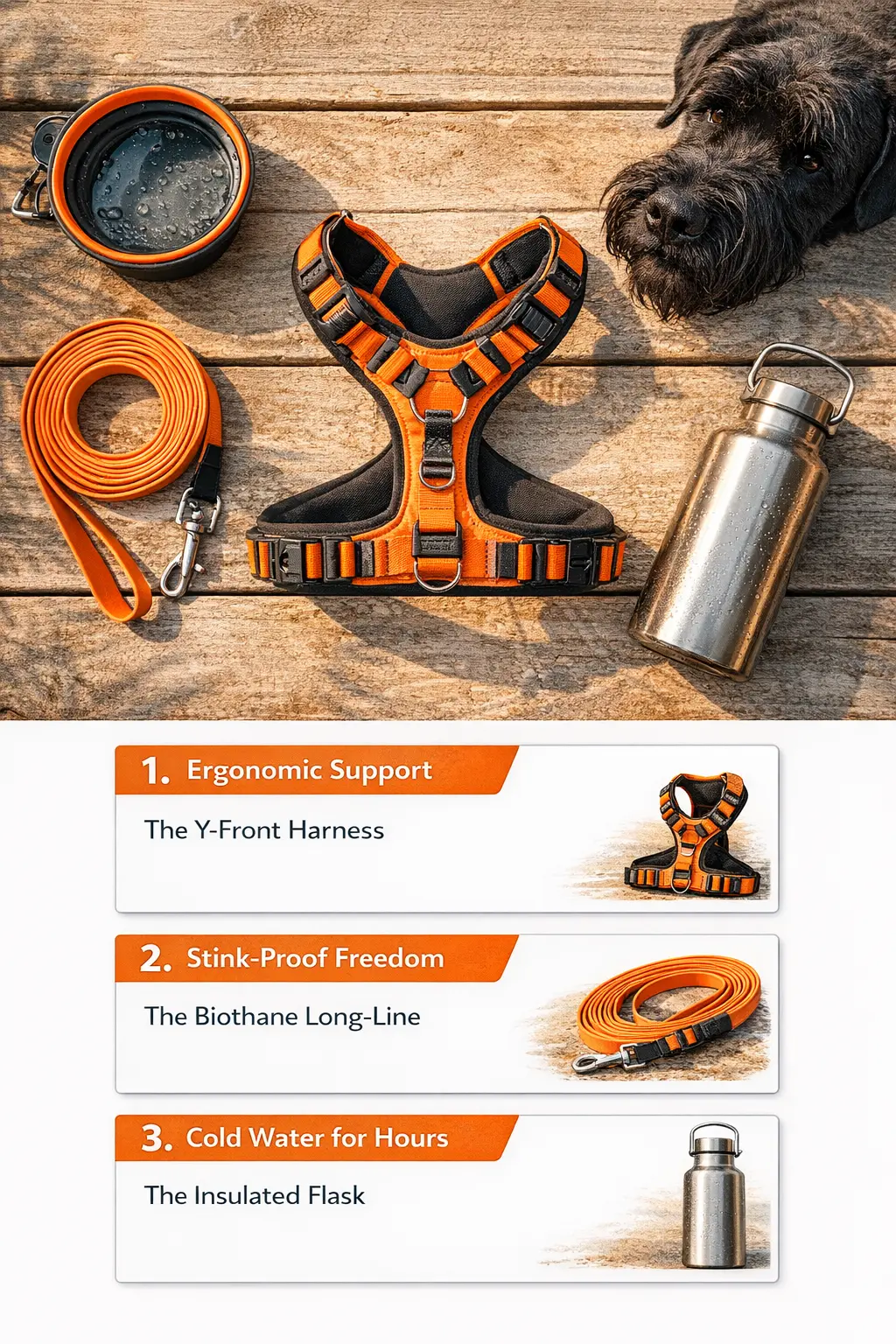
The right gear for a dog outing isn't a fixed shopping list — it depends on the outing itself. A twenty-minute lap of the block asks almost nothing of your kit. A half-day hike, a beach trip, or a few hours in the car on a road trip asks a lot more. This guide works from the outing back to the gear: what to take, how to fit it, and what changes with the terrain, the weather and your own dog. For curated product picks, see our Gear guide — this page is about the planning that comes before you buy anything.
Start With the Outing, Not the Shopping List
Before you pack anything, work out what the outing actually demands: how long you'll be out, the terrain underfoot, the weather and how it might change, whether there's reliable drinking water along the way, and how far you'll be from help if something goes wrong. Then factor in your dog — their size, age, fitness, coat, any health conditions, and how they behave around traffic, other dogs and wildlife. Local hazards matter too, from stinger season on a beach walk to ticks on a bush track. A fit, healthy dog on a familiar twenty-minute suburban walk needs a fraction of the kit the same dog needs for a remote half-day hike in summer heat — carrying gear you don't need just adds weight, not safety.
The Everyday Baseline
For most outings, a simple baseline covers you:
- A well-fitted lead
- A harness or collar suited to your dog and the activity
- Current ID, with up-to-date microchip details
- Drinking water and a portable bowl
- Waste bags
- A charged phone
- Basic first-aid essentials
- Any medication your dog needs
Not every outing needs every item — a quick loop of a familiar park rarely calls for more than a lead, bags and water. Treat this as a starting point, then add or drop items based on the outing in front of you.
Getting the Harness or Collar Right
Harnesses
A well-fitted harness sits securely without shifting, sits close to the body without rubbing at the armpits or chest, allows full and unrestricted shoulder movement, and is snug enough that your dog can't back or wriggle out of it — check this with a proper fit test, not just by eye. Y-front (rather than straight-across) chest designs tend to give the most natural range of shoulder motion, which matters more the longer or more active the outing. The right style also depends on the activity: a lightweight, breathable harness suits humid, high-effort walks, while a sturdier build earns its keep on rough scrub or thick bush where straps take more abrasion.
Collars
If your dog wears a collar for tags rather than walking control, make sure it's fitted correctly — snug enough that it can't slip over the head, loose enough to comfortably fit two fingers underneath — and check the buckle, D-ring and tag attachment regularly for wear. We don't recommend collars designed to correct behaviour through discomfort. If pulling or reactivity is the issue, a well-fitted harness paired with training is the safer starting point.
Lead vs Long Line
Standard Lead
Best for close control in:
- Urban and suburban walking
- Roads and car parks
- Busy paths, beaches or trailheads
Long Line
May suit:
- Controlled freedom in open space
- Recall training where it's safe to fail
- Off-track areas where long lines are permitted
A long line isn't a fit for every environment — keep it away from traffic, stay alert to tangling, never wrap it around your hand, and give other people and dogs plenty of room while you're managing it. Waterproof materials such as biothane hold up well to repeated wetting on beach or creek days and wipe clean rather than holding grit and salt like a natural-fibre line. It's also a solid choice if you're working on Rocket Recall training in a safe, open space.
How Much Water to Carry
Water is essential kit for anything longer than a short walk, and Australian heat and humidity raise the stakes. Carry more than you think you'll need, with extra margin on hot days, and bring a portable bowl rather than relying on your dog to drink from puddles or troughs. On longer routes, check whether refill points actually exist — don't assume — and on remote routes, plan on carrying all the water you'll need, since there's no tap to fall back on.
Having water on hand doesn't make it safe to keep exercising hard in dangerous heat. See Tropical Dog Safety: Beating the Heat for how to judge when it's time to stop rather than push on.
Weather-Specific Gear
Hot Conditions
Extra water, a shade option, and a cooling mat or vest where it genuinely suits your dog can all help. Keep an eye on what the ground surface is doing to paws, not just the air temperature. Cooling gear makes hot conditions more comfortable — it isn't permission to keep going in genuinely unsafe heat.
Wet & Cold Conditions
A towel, a waterproof layer for dogs that need one, a warm layer for dogs that genuinely feel the cold, and dry bedding for travel stops all earn their place in southern or wet-weather conditions. Not every dog needs a coat — it depends on coat type, size, age and health, not the calendar. See Winter Dog Safety Across Australia for how this varies region by region.
Do Dogs Need Boots?
Not automatically. Boots can help on sharp terrain, hot surfaces, snow or ice, with injured or sensitive paws, or in specific working or travel contexts. But fit matters, dogs need gradual acclimation before relying on them, a poor fit can rub, and boots don't make extreme surface heat safe on their own — the back-of-your-hand pavement test still applies.
Boots or not, get into the habit of checking paws after any outing on rough or hot terrain — for cuts, grass seeds, burrs, cracks, embedded debris and burns.
Building a First-Aid Kit
A sensible kit for outings might include:
- Gauze
- Non-stick dressings
- Bandage material
- Saline
- Tweezers or a tick-removal tool
- Emergency contact details, including the nearest vet on unfamiliar routes
A first-aid kit supports getting your dog to a vet — it doesn't replace one. Keep it to sensible basics rather than complex treatments, and don't pack medication without veterinary guidance on what and how much. Where a specific emergency is covered in detail elsewhere on this site, use that guide rather than relying on general first aid alone.
Ticks and Parasites
Heading somewhere bush, coastal or interstate is a good prompt to check your dog's parasite prevention is current, pack an appropriate tick-removal tool if you're headed somewhere tick-prone, and get a sense of regional tick risk before you arrive. See our National Dog Tick Safety Guide and Dog Parasite Prevention in Australia for prevention schedules and product guidance — this page is about packing for the trip, not the ongoing prevention plan.
Snakes, Wildlife & Regional Hazards
Different parts of Australia carry different hazards worth knowing about before you set off — snakes in bushland, cane toads in warmer regions, marine stingers on tropical and subtropical beaches, 1080 baiting in some rural and conservation areas, and local wildlife that can trigger a chase. A quick check of what applies to your destination is worth the five minutes it takes. These are planning reminders, not treatment guides — for what to actually do if something happens, use:
- Snake Bite Emergency Protocol (Australia)
- Emergency Protocol: Cane Toad Poisoning
- Stinger Season: Keeping Dogs Safe at the Beach
Identification
Keep microchip details current — this matters more than a tag if your dog goes missing somewhere unfamiliar. A collar tag with a current phone number gives whoever finds your dog a fast first point of contact. Travelling somewhere for a while? Consider adding temporary contact details for where you're staying, since a home number alone might not get you a call back quickly enough. ID tags back up microchipping; they don't replace it.
Lighting & Visibility
For early-morning, evening or low-light outings, a reflective lead or harness trim, a small clip-on safety light for your dog, and a torch or headlamp for yourself go a long way. None of this needs to be high-tech — the goal is simply being seen by traffic and other trail users.
Road Trips
For any vehicle-based outing, think through a secure restraint or crate, water, bedding, planned rest stops, medication, and documents and emergency contacts you can find quickly. Our National Dog Travel Checklist covers this in full — the short version here is to work out what this specific leg of the trip actually needs before you're already on the road.
Remote Travel
Genuinely remote travel needs extra planning: carry meaningfully more water than a normal outing, know where the nearest vet or emergency clinic actually is before you need one, expect phone coverage to drop out, let someone know your planned route where that's sensible, carry any medication your dog needs, and check local restrictions and hazards ahead of time. None of this is a reason to avoid remote travel with your dog — it's a reason to plan for it properly rather than assuming your normal kit will cover it.
Adjusting the Kit for Your Dog
The right kit shifts with the dog in front of you. Puppies and seniors often need shorter outings, easier access in and out of the car, and comfortable rest options. Brachycephalic breeds need extra caution around heat and exertion regardless of how enthusiastic they seem. Large and giant breeds need especially secure, well-fitted equipment, simply because of the force involved if something goes wrong. Small dogs can be more vulnerable to hot surfaces and other animals, and may need more frequent carrying breaks. Reactive dogs often benefit more from distance-management tools — a long line used well away from triggers, or a route that avoids pinch points — than from more gear. Working or high-drive dogs need an owner willing to make the call to stop, since drive can override a dog's own sense of when enough is enough.
Pack Light: Avoid Gear Overload
It's easy to end up carrying gear "just in case" because it's marketed as adventure-ready, rather than because the outing calls for it. Before adding something to the bag, ask: what's actually likely on this outing, what's essential if it does happen, what would genuinely help, and what's just extra weight? For most everyday outings, a small, reliable kit beats a large, complicated one — you're more likely to actually use it, and less likely to be fumbling through a full pack for one specific thing.
Before You Leave: Quick Check
- Lead and harness or collar fit checked
- ID and microchip details current
- Weather checked
- Water packed, with margin for the conditions
- Destination rules checked (leash laws, dog access)
- Parasite prevention current
- Medications packed
- Local hazards considered
- Emergency contact or nearest vet identified for longer or remote trips
Common Gear Mistakes
- Poor harness fit
- Carrying too little water
- Relying on cooling products instead of reducing heat exposure
- Leaving ID details outdated
- Using a long line near traffic
- Buying boots without acclimating your dog to them first
- Packing far more than the outing needs
- Assuming a first-aid kit replaces veterinary care
Sources & Further Reading
Safety information checked against Australian veterinary and animal-welfare sources including:
- RSPCA Australia Knowledgebase — How Can I Protect My Dog From Heatstroke?
- Greencross Vets Australia — Ticks on Dogs: Identification, Symptoms, Prevention & Treatment
- Healthdirect Australia — Snake Bites
This guide has not been reviewed by a veterinarian and is not a substitute for professional veterinary advice for your individual dog. For a specific emergency, use the relevant protocol guide linked above and contact a vet immediately.