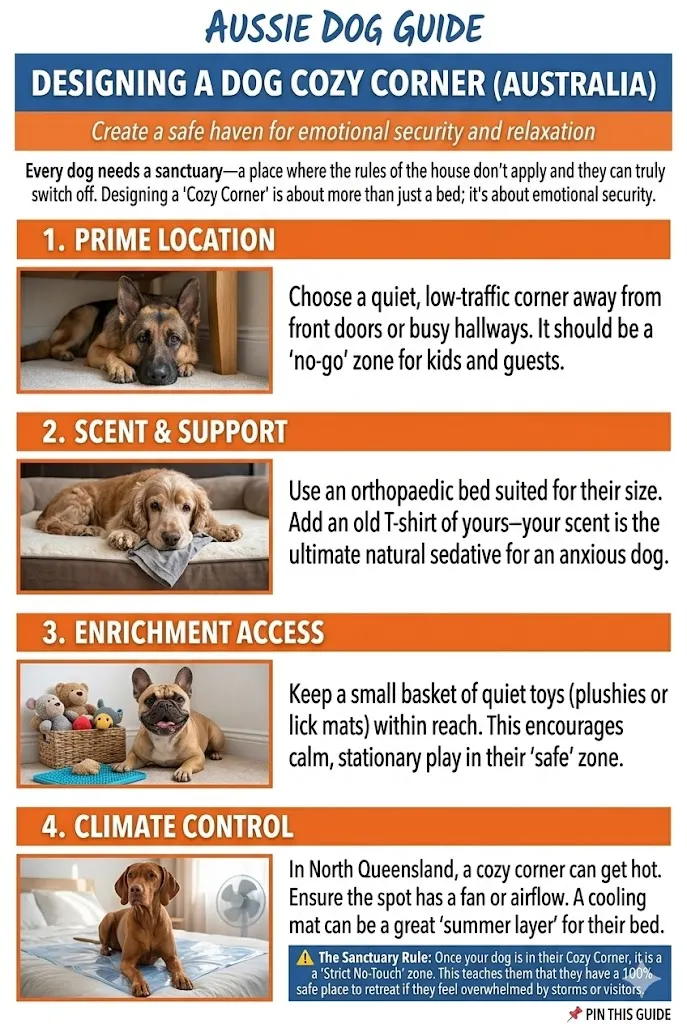
Every dog benefits from a calm space of their own — somewhere they can choose to settle, away from the busy parts of the house. Designing a 'Cozy Corner' is about more than just a bed; it's a space your dog learns to associate with feeling secure, and can retreat to during everyday moments — after activity, when the house is busy, when visitors arrive, when kids are underfoot, or during a storm — not just one of those occasions.
The 4-Step Cozy Corner Protocol
PRIME LOCATION
Generally quiet enough to actually rest in, out of constant foot traffic, and away from doors or windows if those trigger barking. Protect it from direct sun and give it reasonable airflow. There's no single right spot for every dog — some settle better tucked away from the household, others prefer a corner near family activity where they can still see what's going on. Whichever you choose, your dog should be able to enter and leave it freely.
BEDDING & FAMILIAR SCENT
Choose bedding for the dog you actually have: size, age and joint comfort matter, and coat and climate matter too — a dog that runs hot may prefer a cooler, firmer surface over thick plush padding, while a senior or arthritic dog often benefits from more cushioning. A familiar blanket or a worn (unwashed) item of your clothing can help make the space feel predictable and familiar — useful, but not a fix for anxiety on its own. Skip loose fabric or stuffing for a dog that chews and swallows material.
ENRICHMENT ACCESS
A quiet chew, lick mat or familiar toy can sit nearby if your dog enjoys settling with one — but keep it to that. For detailed enrichment choices and how to match them to your dog, see Dog Enrichment Tools & Activities.
CLIMATE CONTROL
Wherever you are in Australia, avoid a spot that ends up hot, stuffy, damp, sun-exposed, or blasted directly by a heater or air-con. Check airflow, floor temperature, and whether bedding thickness suits the season — a cooler surface or a fan in summer, a warmer layer or draft-free corner in winter.
Voluntary Use, Not a Place They're Put
A cozy corner works because your dog chooses it, not because they're placed there. Let your dog investigate the space in their own time, reward calm entry and settling with a treat or quiet praise, and occasionally leave a treat there to build a good association. Never drag, push or shut a dog into the space to "make them calm down" — used that way, it stops being a retreat and starts being confinement, which undermines the whole point.
When your dog chooses to rest in their Cozy Corner, the household should respect that — no climbing in, no patting, no waking them for a cuddle. With kids, this means teaching them not to climb into the dog's bed and to leave a resting or sleeping dog alone, with adult supervision around the space. This isn't a rule that suspends normal handling — if your dog genuinely needs to be moved or checked on (an emergency, a vet concern), ordinary handling still applies; it just shouldn't happen there as a matter of casual habit.
Noise & Light
Some dogs settle better with lower household traffic, softer lighting, and a predictable background sound rather than sudden noise. A white noise machine or low, calm audio can help mask sudden outside noise for some dogs — it's a helpful management tool, not something that treats anxiety on its own.
Does It Have to Be a Crate?
No. A cozy corner can be a bed, an open crate, a mat, a gated nook, or simply a quiet corner of a room — whatever suits your space and your dog. If your dog is already crate trained and comfortable there, an open crate can double as part of the setup, but crate use isn't required to create a cozy corner.
Adjusting for Your Dog
Puppies and seniors often need easier, lower access. Large dogs need a bed genuinely sized for them; small dogs may prefer a more enclosed, den-like spot. A dog with mobility issues benefits from flat, easy entry with no step or awkward angle. Some dogs prefer a fully enclosed, den-like space; others settle better somewhere more open with a clear view of the room. None of this is fixed by breed — watch what your own dog actually gravitates toward.
If Your Dog Avoids the Space
Signs the setup isn't working include your dog avoiding the area altogether, seeming restless once there, or only using it briefly before moving on. Common causes are a spot that's too hot, cold or high-traffic, disturbance from other pets or children, uncomfortable bedding, or a location too close to something that triggers barking or alertness. Change one factor at a time rather than overhauling the whole setup, make the space more genuinely comfortable, and rebuild a positive association gradually — never force your dog to use a space they're avoiding.
When a Cozy Corner Isn't Enough
A calm space supports rest and predictability, but it doesn't treat severe separation distress, significant storm phobia, pain, illness, or serious behaviour problems on its own. If your dog is using the space as part of alone-time preparation, see the Home Alone Blueprint for the full departure-training plan. If storms are the trigger, a familiar retreat can genuinely help in the moment, but storm-specific activity and preparation belongs on Storm-Bound Boredom Busters and the Storm Safety Blueprint. If you're seeing panic, self-injury, severe distress, or a sudden change in behaviour, that's a job for veterinary or qualified, reward-based behavioural support, not space design alone.
Sources & Further Reading
- AVSAB — Position Statements on Humane, Reward-Based Training
- RSPCA Australia — The Deal with Dog Training
This guide has not been reviewed by a veterinarian or veterinary behaviourist and is not a substitute for professional advice for your individual dog.