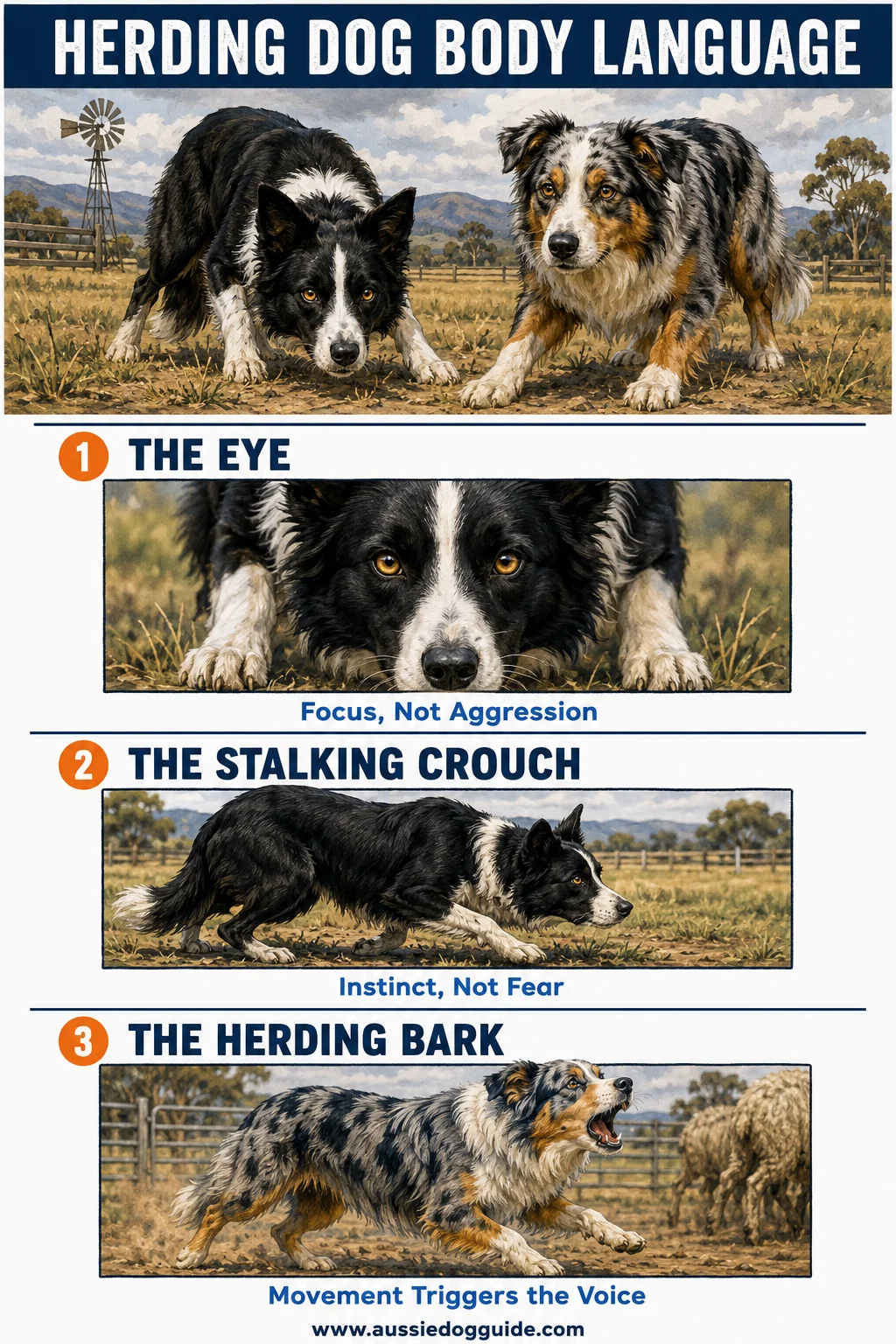
Herding breeds communicate differently to most dogs — their body language evolved to control livestock, not just express emotion. If your dog stares, crouches, circles or nips at heels, that's often instinct rather than misbehaviour. But herding drive doesn't cancel out ordinary canine communication, and the same behaviours can still become unsafe or frightening depending on intensity, context and target. For general canine stress, fear and relaxation signals, start with Reading Dog Body Language — this guide focuses specifically on movement-control behaviours common in herding dogs.
"The Eye": Why They Stare
That intense, unblinking stare — often aimed at you, the vacuum cleaner, or a tennis ball — is called "giving eye" in herding terminology. Some herding dogs use this sustained visual focus, often paired with a lowered head, stillness and a slow approach, to control movement without physical contact. It's usually focus rather than aggression or a challenge — but context matters, and it's worth breaking the stare yourself if it turns into fixation the dog can't disengage from, since prolonged, unbreakable fixation can precede chasing behaviour and isn't something to romanticise just because it looks impressively focused.
Stalk, Crouch, Freeze
The classic herding sequence — lowering the body, creeping forward, freezing, then suddenly accelerating when the target moves — is instinct, not fear. But a freeze isn't always the same thing, and it's worth telling the two apart. A herding-style freeze is usually paired with forward attention, target focus and obvious readiness to move. A fear-related freeze more often comes with avoidance, a tucked posture, weight shifted away, and other broader stress signals like lip licking or a lowered tail. This isn't a perfect diagnostic rule — read the whole body and the context, not just the freeze itself.
Circling & Blocking
Some herding dogs naturally try to flank, circle, intercept or block movement — instinctively gathering whatever's moving. This can show up around children, running dogs, bicycles, joggers, livestock, or simply family members moving through the house. It's genuinely instinctive, but that doesn't mean it should be allowed to run unchecked — don't let a dog rehearse unsafe chasing or blocking just because the underlying drive is natural.
Heel Nipping & Mouthing
Some herding breeds target heels or ankles when movement triggers drive — this is instinctive, but instinctive doesn't mean harmless. It shouldn't be allowed around children, runners, cyclists or strangers regardless of the reason behind it. Punishing nipping after arousal is already high tends to increase arousal or fear rather than resolve it; management (preventing the rehearsal in the first place) and reward-based redirection toward an appropriate outlet are the safer path.
Arousal Escalation
Herding-drive behaviour tends to build rather than appear all at once — intervening early is easier than managing full escalation.
Early
- Staring, orienting toward the target
- Crouching
- Slow stalking
More Aroused
- Faster circling
- Barking, lunging
- Nipping
- Inability to disengage
When the Dog Can't Disengage
A healthy working drive should still be manageable — your dog should be able to come back to you. It's worth taking more seriously when a dog can't respond to known cues once fixated, becomes frantic around movement, repeatedly chases children, traffic or bikes, can't settle after activity, guards access to moving targets, or redirects onto handlers or other dogs. That pattern is worth qualified, reward-based behavioural help rather than managing around indefinitely — though it's not something to casually label a compulsive disorder without a proper assessment.
Play vs. Herding With Other Dogs
Herding dogs often mix play with chase, stalking and body-blocking, which can make dog-to-dog interaction look unusual even when it's genuinely mutual. Watch the other dog's response rather than just your own dog's intent: if the other dog is repeatedly trying to escape, hiding, becoming defensive, or looks overwhelmed, interrupt the interaction — even if your dog still looks "playful" from where you're standing.
Children
Running, squealing children can strongly trigger movement-control behaviour. Supervise interactions, prevent the dog rehearsing chasing or nipping around kids, separate calmly when things are building, and offer structured alternative activities instead. Children shouldn't be used as training props for working through a dog's drive.
Bikes, Runners & Cars
Fast movement can trigger pursuit, and dogs shouldn't be allowed to rehearse chasing bikes, lunging at runners, or chasing vehicles — each rehearsal makes the next one more likely. Manage with distance, solid lead control, and reward-based disengagement training. See The Emergency U-Turn for redirecting away from a trigger in the moment, and The Focus Bridge (LAT Method) for building calmer responses to movement over time.
Safe Outlets
A herding dog doesn't need livestock to have a legitimate outlet for the drive. Structured herding where it's safely and legally available is one option, but treibball, scent work, obedience, controlled retrieve or search games, shaping, movement-control games and puzzle or problem-solving work all give the same underlying drive somewhere appropriate to go. See Dog Enrichment Tools & Activities for the broader range of ideas and how to match them to your dog.
Teaching an Off-Switch
Herding dogs also need to learn rest, disengagement, calm observation and settling after activity — high drive doesn't mean endless stimulation is the goal. Constantly trying to physically exhaust a high-drive dog tends to build fitness rather than teach calm; both structured outlets and deliberate practice at switching off matter.
Breed Nuance
These are tendencies, not guarantees — working-line dogs are often more intensely driven than pet-line dogs of the same breed, and individual temperament and learning history matter more than breed label alone.
Border Collie body language
The Border Collie's signature is "the eye": a fixed stare with the head lowered, then a crouch and a slow, usually silent stalk, with the tail carried low. When the target moves, they accelerate. Early signs worth interrupting are a stare that won't break and a stalk that speeds up, before it becomes chasing or nipping.
Australian Shepherd body language
An Australian Shepherd may hold a softer but steady gaze and drop its body low, and tends to be more vocal than a Border Collie, with a sharp herding bark when movement excites it. Some also bump or lean into people and other animals. Despite the name, the Australian Shepherd was developed in the United States; the Kelpie and the Australian Cattle Dog are the Australian-bred herding breeds.
- Border Collies — often strong visual eye, stalk and fixation
- Kelpies — often strong movement sensitivity, gathering/circling and endurance
- Australian Cattle Dogs — may show more direct movement control and heel targeting
- Australian Shepherds — may combine movement control with alert or guarding tendencies, and tend to be more vocal, often with a sharp "herding bark" during movement-triggered excitement; some also "bump" or lean into people and other animals as a herding-adjacent behaviour
Ordinary Stress Signals Still Matter
Herding behaviour doesn't cancel out ordinary canine stress signals. Lip licking, yawning, whale eye, a tucked tail, avoidance, stiff posture or growling are all still worth reading in context, whatever the breed. See Reading Dog Body Language for the general signals this guide doesn't re-cover.
Common Owner Mistakes
- Assuming every stare is aggression
- Assuming every stare is "just herding" and never worth interrupting
- Letting the dog chase children or bikes "for practice"
- Punishing nipping only after arousal is already high
- Waiting too long to interrupt fixation
- Trying to physically exhaust a high-drive dog instead of managing drive properly
- Ignoring the other dog's discomfort during "play"
When to Seek Help
Get qualified, reward-based behavioural support if nipping is frequent or escalating, your dog chases dangerous targets, they can't disengage, household members are frightened, other pets are being harassed, or fear or aggression may also be involved alongside the herding drive. A sudden change in behaviour is worth a veterinary assessment as well, in case something else is going on.
Sources & Further Reading
- AVSAB — Position Statements on Humane, Reward-Based Training
- RSPCA Australia — The Deal with Dog Training
This guide has not been reviewed by a veterinary behaviourist and is not a substitute for professional advice for your individual dog. For nipping, chasing or fixation that's frequent, escalating or frightening, seek qualified, reward-based behavioural support.