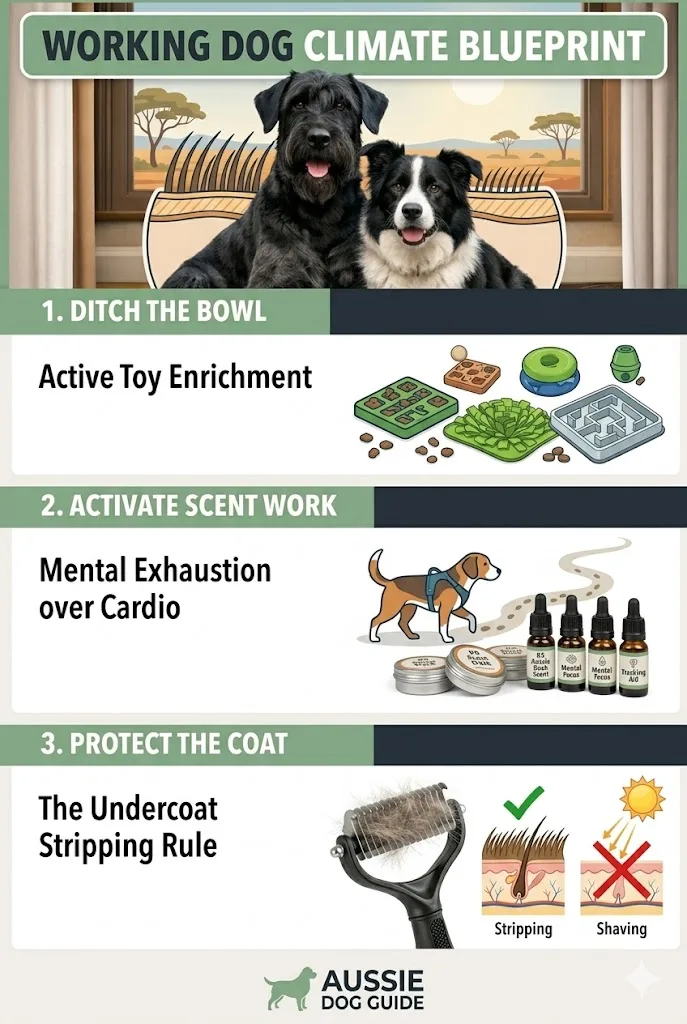
When extreme weather — whether it's a soaring 40°C summer day in inland Australia or high humidity through a northern wet season — makes normal exercise risky, preparation is the difference between a dog that copes well and one that overworks itself. This blueprint is for working, sporting, herding, guarding and other high-drive dogs: the ones that don't reliably decide for themselves when it's time to stop.
The Myth of the Backyard "Self-Exerciser"
A common misconception is that leaving a high-energy dog in a large backyard provides enough physical stimulation. Working breeds don't self-exercise; without structured tasks, they turn their drive inward, resulting in compulsive fence-running, destructive digging, or excessive barking at boundary lines.
High-Drive Dogs Often Don't Know When to Stop
A dog absorbed in chasing, retrieving, running, herding, working, training or hiking will often keep going well past the point where it's safe, because drive and focus can override the instinct to slow down. This can be especially pronounced in Border Collies, Kelpies, Australian Cattle Dogs, working-line Shepherds, retrievers, sporting dogs, and protection or guarding breeds — but it's an individual trait as much as a breed one, and plenty of dogs outside these groups have the same problem. Don't rely on your dog to choose to stop; that decision needs to be yours, based on conditions and how the dog is actually coping, not how keen they still look.
Workload Should Change With the Weather
There's no single "safe" temperature that applies everywhere or to every dog — heat risk comes from a combination of factors, and a fit working dog is not immune to it. Adjust workload based on:
- Temperature and humidity together, not temperature alone
- Direct sun exposure and wind or airflow
- Session duration and intensity
- Terrain and surface heat
- Fitness, body condition and age
- Coat type
- Any existing medical conditions
Why Humidity Matters
Dogs cool themselves mainly through panting — moving air over moist surfaces so evaporation carries heat away. High humidity slows that evaporation down, so a dog can struggle even on a day where the air temperature alone doesn't look extreme. This is a bigger factor for more of the year in northern Australia's tropical humidity, but it applies anywhere the weather turns humid, not just the tropics.
Timing Sessions
Cooler early-morning periods are generally the safer window, and an evening session only makes sense once conditions have genuinely cooled — not just once the sun's gone down. Avoid peak heat, and check forecast humidity as well as temperature before you commit to a session. Don't assume dawn or dusk is automatically safe: in some regions and seasons, humidity stays high at those times too, and a warm, still night gives a dog less chance to properly recover before the next day's session.
Reduce Intensity Before Cutting Duration Alone
A dog doesn't need to work at full intensity every session. Before simply shortening a session, consider adjusting:
- Speed and repetition count
- Work-to-rest ratio
- Terrain and activity type
In practice that might mean fewer retrieves, shorter training blocks, more sniffing or search work in place of sprinting, a slower route, shaded sessions, or skill work instead of repeated hard running.
Work-Rest Cycles
Use short blocks of activity broken up with deliberate rest, rather than one long continuous session. Rest should genuinely mean shade, airflow, access to water, and enough time for breathing and behaviour to settle before starting again — not just a pause. There's no universal ratio that fits every dog; let the individual dog and the day's conditions set the pace.
Water
Reliable access to fresh water matters throughout a session, not just at the end. Carry enough for active work, offer it regularly rather than waiting until your dog looks obviously distressed, and don't force large volumes at once. Water helps, but it isn't a safety guarantee on its own — a dog working hard in genuinely dangerous conditions can still overheat with water on hand.
Cooling Between Work Blocks
This is everyday recovery, not emergency treatment. Between blocks of activity, useful measures include shade, airflow, a cool surface to lie on, water, loosening or removing harness and gear where it's safe to do so, and moving into air conditioning after work where that's available. If you see serious heat signs — staggering, confusion, vomiting, collapse, seizures or breathing difficulty — that's the Dog Overheating Emergency Protocol, not everyday cooling.
Recognising When a Dog Isn't Coping
Watch for early signs so you can stop before things escalate, rather than waiting to see how far a dog will push:
- Panting becoming increasingly heavy
- Slowing down or poor recovery between repetitions
- Reduced responsiveness or reluctance to restart
- Seeking shade unprompted
- Excessive drooling
- Unusual gait or reduced coordination
Don't tell a keen dog to push through early warning signs. Staggering, confusion, vomiting, collapse, seizures or breathing difficulty mean stop immediately and go straight to the Dog Overheating Emergency Protocol and a vet.
Performance Can Drop Before Collapse
A slower response, missed cues, reluctance, sloppy movement or delayed recovery between reps can all be an early sign something's wrong, not just a training lapse. Don't automatically read a performance drop as disobedience — heat, fatigue, pain or illness can all look like a dog that's suddenly "not listening."
Acclimatising to a Hotter Climate
A dog moving or travelling from a cooler region into a hotter one may need time to adjust, but acclimatisation doesn't make a dog heat-proof — even a well-acclimatised dog can still overheat in the wrong conditions. Start conservatively, increase workload gradually, watch how well the dog recovers between sessions, and scale back further during unusually hot or humid stretches even once your dog seems settled into the new climate. There's no fixed number of days that applies to every dog; go by recovery, not the calendar.
Body Condition
Healthy body condition is part of heat tolerance — an overweight dog generally carries greater heat risk during work. If body condition is a genuine concern, that's worth raising with a vet rather than adjusting through exercise alone.
"Never shave a double-coated working dog in an Australian summer. It strips their natural insulation, exposing the skin directly to solar radiation, significantly increasing the risk of heatstroke and severe sunburn."
Coat & Grooming
A double coat acts as a thermal barrier, trapping a layer of cooler air close to the skin while helping deflect radiant heat — coat management isn't one-size-fits-all, and clipping a double coat doesn't automatically improve heat tolerance the way it's sometimes assumed to. Keep the coat free of heavy matting, remove loose undercoat with proper de-shedding tools, and keep skin and coat generally healthy. For tool recommendations and technique, see Dog Grooming Tools.
Equipment
Working gear — heavy harnesses, packs, protective equipment, coats or vests, long working leads — can add real heat and load on top of the activity itself. Check fit, weight, ventilation and rubbing, and ask whether the piece of equipment is actually needed in the day's conditions rather than defaulting to the full kit every time.
Cooling Vests & Mats
These are optional management tools, not a licence to work harder — effectiveness varies by product, design and environment, and none of them override genuinely dangerous conditions. Keep monitoring your dog exactly as you would without one.
Hot Surfaces
A focused working dog may push straight through paw discomfort on hot pavement, concrete, sand, artificial turf, a ute tray or rock without slowing down. See Tropical Dog Safety: Beating the Heat for the full surface-safety check.
Mental Work as a Substitute for Some Physical Load
On high-risk weather days, reducing physical workload and substituting mental work can fill part of the gap — though it doesn't fully replace normal exercise as a long-term routine.
- Scent Work and Tracking: Hiding scent markers forces intense focus, naturally lowering heart rates while draining mental energy.
- Structured Shaping Games: Clicker training or marker words to teach complex multi-step behaviours, like cleaning up toys into a basket.
- Controlled Search or Problem-Solving Games: Structured "find it" tasks or a puzzle feeder used as a job rather than a snack.
For a full breakdown of enrichment types and how to match them to your dog, see Dog Enrichment Tools & Activities.
Different Types of Working Dog
Think about workload characteristics rather than breed stereotypes:
- Herding/movement-driven dogs — strongly motivated by movement and chase, which can override normal self-limiting
- Retrieving/sporting dogs — repeated sprinting or retrieving can accumulate heat load quickly
- Guarding/protection dogs — training can involve high arousal and heavy equipment on top of exertion
- Hiking/running companions — sustained endurance activity builds heat load gradually rather than all at once
Vehicles & Ute Trays
Working dogs often spend real time in vehicles, crates, ute trays or trailers before and after activity. Check ventilation, shade, surface heat and actual vehicle temperature, and use secure restraint throughout. This isn't the full emergency picture for vehicle heat — see the Dog Overheating Emergency Protocol for that.
Recovery After Work
Let breathing settle before rushing to the next thing, offer water, move to a cool environment, and check paws and coat/skin for anything picked up during the session. Watch behaviour for the rest of the day — a dog that stays unusually lethargic, distressed or unwell after activity is worth a vet call rather than a wait-and-see approach.
Next-Day Recovery
High-drive dogs can look eager again well before they've actually fully recovered. Watch for stiffness, unusual fatigue, reduced appetite, reluctance to work, or other abnormal behaviour the next day. This isn't a diagnosis of anything specific — but a change that persists is worth a veterinary assessment rather than assuming it will pass.
Pre-Work Checklist
- Weather and forecast checked, including humidity
- Route or work area assessed
- Water available
- Shade or rest option available
- Surface temperature considered
- Dog fit and healthy for the session
- Equipment appropriate for the conditions
- Emergency vet plan known if working somewhere remote
- Workload adjusted for today's conditions, not a default plan
Remote & Rural Work
Working somewhere remote adds planning on top of the heat management above: carry more water than usual, know the limits of phone coverage where you're working, know the nearest veterinary service, factor in snake, tick and other wildlife risk, and carry appropriate first-aid equipment. See National Dog Tick Safety Guide, Snake Bite Emergency Protocol and National Dog Travel Checklist for the detail behind each of these.
When to Stop the Session
Keep the decision simple: if your dog isn't recovering normally, behaviour or performance is changing, or heat signs are escalating, stop the session. Don't wait for collapse to make the call.
Sources & Further Reading
- RSPCA NSW — Heat Stress
- Greencross Vets Australia — Heat Stroke & Stress in Dogs
- Animal Emergency Service Australia — Heat Stroke in Dogs
This guide has not been reviewed by a veterinarian and is not a substitute for professional veterinary advice for your individual dog. For suspected heatstroke, use the Dog Overheating Emergency Protocol and contact a vet immediately.